Gas Safe registered

Viessmann specialists

Vitodens 050, 100 and 200, and the older Vitopend. Twenty years on Viessmann boilers, rates agreed beforehand, and parts guaranteed for a year.
Answered 24 hours a day by a technical customer service member.
Viessmann use F, A and B codes, and some models add a second pair of letters. Read us everything on the screen.
No heating or hot water right now? Call 0203 868 6134. We will tell you the earliest realistic slot rather than the one you want to hear.
Two details to start. Add the fault code and your postcode and we can usually tell you the likely part before we attend.
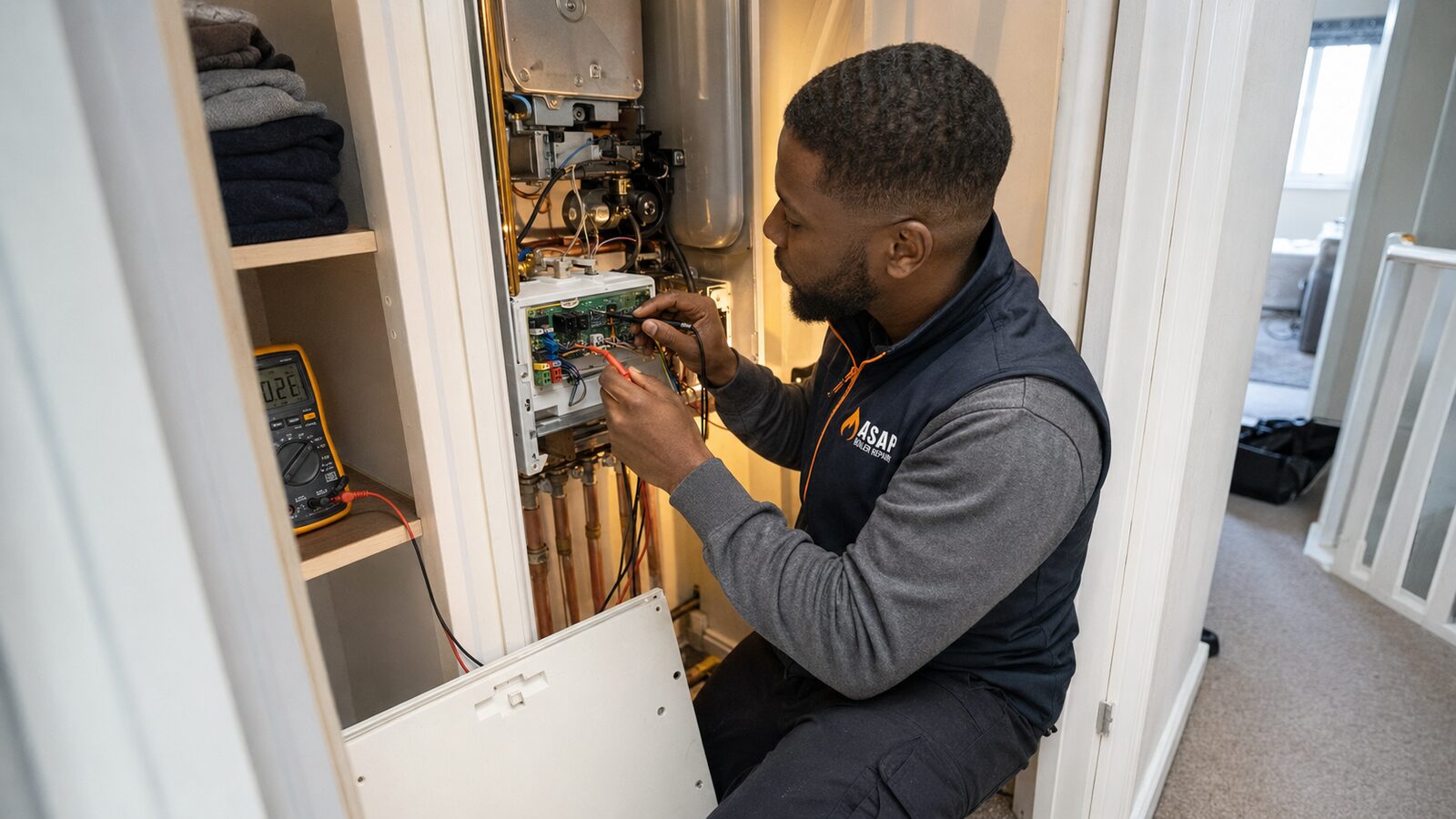
Three steps, no sales pitch, and you will know where you stand before an engineer is booked.
A Viessmann is not a boiler to adjust by feel. The combustion is controlled electronically and calibrates itself, so the gas valve is not something an engineer sets by hand the way it is on many other makes. If somebody has been turning things to make a fault go away, tell us, because that changes what we need to check before anything else.
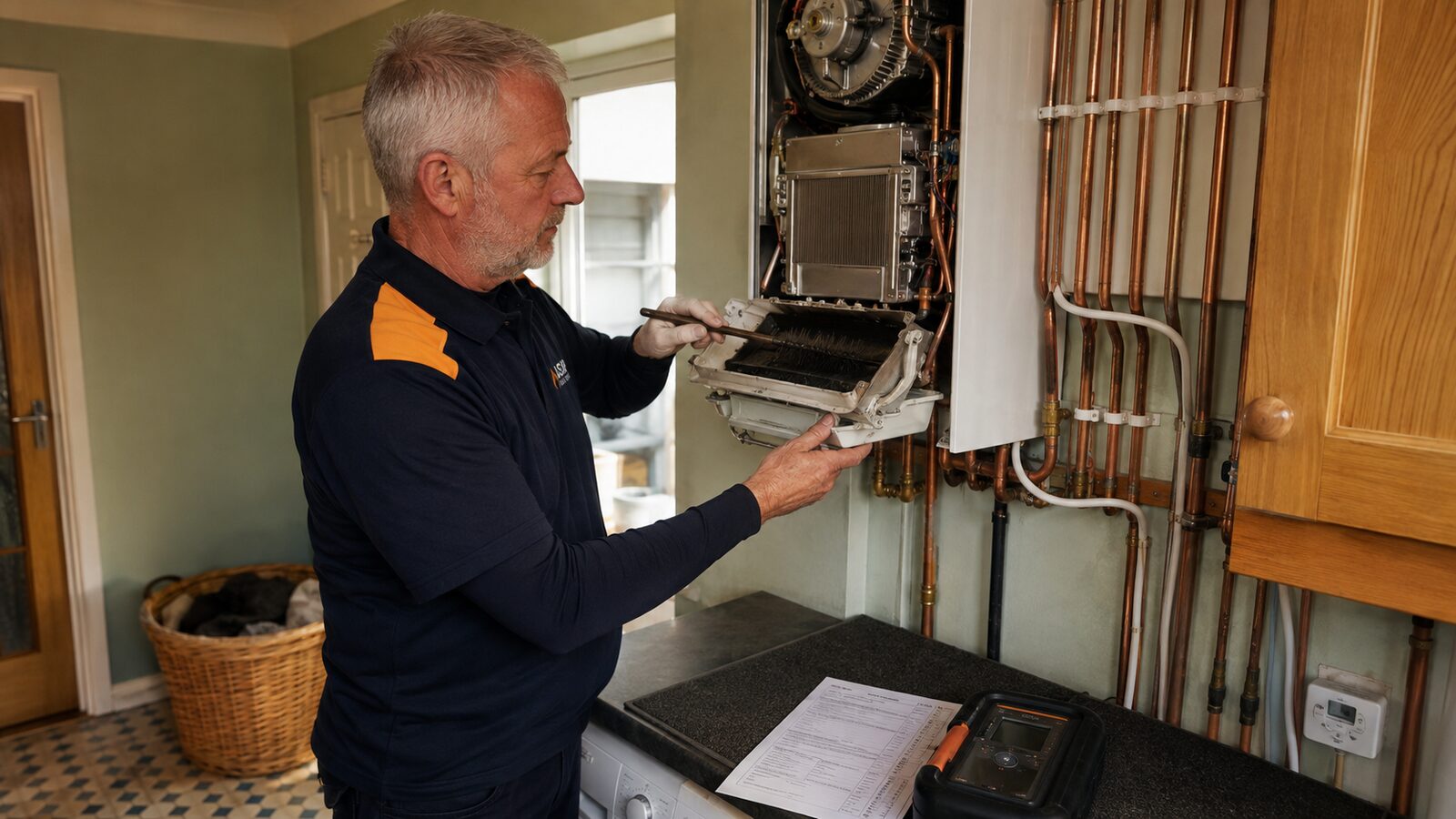
Viessmann failures concentrate around combustion and sensing rather than around mechanical wear. Six parts cover most of what we attend.
Viessmann use a mix of F, A and B codes across the Vitodens and Vitopend ranges, and the meanings are not identical between them. Two reputable sites will tell you different things about F2, and both will be right about some model. The manual for your appliance is the only list guaranteed to be right about yours.
What the boiler is saying: it went through its ignition sequence and never received an ionisation signal confirming a flame, so it shut the gas off.
Nine times in ten: the ionisation electrode or its lead, dirty, worn or cracked so the signal never reaches the board. Then the ignition electrode, then the gas pressure at the appliance, then the valve block.
Check first: does anything else in the house run on gas? A hob that will not light points at the supply. In cold weather, check the plastic condensate pipe outside for ice, because a blocked condensate route produces this on many Viessmann models.
Why the electrode matters more here than on other makes: on a Viessmann the ionisation electrode is not only a flame detector, it also feeds the combustion control. A dirty one degrades how the boiler runs before it ever locks out, so this fault often has a history you did not notice.
One reset only. If it locks out again straight away, stop.
Is it freezing outside, and does the hob light? Two quick answers.
On most Vitodens models F2 means the safety temperature limiter has disconnected and the burner is blocked as a result. This is the code the online lists disagree about most, because on some models and some older ranges it is described differently, so treat any generic answer with caution and check your own manual.
Nine times in ten: circulation rather than the burner. The manufacturer's own guidance points first at the filling level, the circulation pump and air in the installation, which is another way of saying the water is not moving heat away fast enough.
What to stop suspecting: the limiter itself, which is the part reporting the problem. Replacing it without addressing the circulation buys you days.
Worth checking yourself: the pressure gauge, and whether any radiator has gone cold since this started. Both point at the same cause.
What helps most: clearing the sludge and air out of the system rather than swapping a component.
What does the pressure gauge read, and are any radiators cold?
The board saw an ionisation signal at the moment the burner started, before there should have been any flame at all, so it locked out.
Nine times in ten: the ionisation electrode or its connecting cable giving a false reading, very often because of moisture or condensation tracking across the connector.
Why it matters more than most codes: almost every other fault means the boiler stopped when it should have. This one means the boiler saw something it could not account for on the gas side, which is a different order of problem and not one to sit on.
What to stop suspecting: something to keep resetting. This is a gas safety lockout and the boiler is refusing to run for a reason worth respecting.
Leave it switched off at the fused spur and call us.
On the ranges that use one, F5 means the air pressure switch was not in the state the boiler expected: either not open when the burner started, or not closing once the fan reached ignition speed.
Nine times in ten: the flue or air intake rather than the switch. A terminal packed with leaves or nesting material, a route that has sagged and collected water, or the small hose that connects the switch to the pressure tapping perished or fallen off.
What is worth checking outside: the flue terminal on the wall. This code turns up after heavy weather more often than at any other time, which is a strong clue in itself.
What to stop suspecting: a reason to replace the switch first. The switch is usually correct about what it is measuring.
Has there been heavy rain or wind recently? That is a real clue here.
The boiler asked the fan to reach a set speed before lighting and it did not get there in time, so the sequence was abandoned.
Nine times in ten: the fan, its power supply, or the wiring between the fan and the board. On a Viessmann the check on start-up speed is tight, so a fan that is merely tired can produce this before it becomes obviously noisy.
The warning you may have had: a boiler that takes longer than it used to before it lights, or that occasionally fails and then succeeds on the second attempt.
What to stop suspecting: only the fan. A restricted flue makes a healthy fan work against resistance it cannot overcome in the time allowed.
Does it take longer to light than it used to? That is this fault, earlier.
Viessmann separate these usefully, and the distinction saves money.
F30 is a short circuit to the boiler temperature sensor. F38 is an interruption to it, meaning an open circuit. F50 is the hot water sensor on models with a store.
Why the difference matters: an open circuit is very often a connector that has worked loose or a wire chafed against the casing, which costs almost nothing to put right. A short circuit is more likely to be the sensor itself. An engineer who reads the code properly checks the plug before ordering the part.
What you will notice: often nothing dramatic. The boiler may run at the wrong temperature or refuse to heat hot water while the heating works perfectly.
Is it heating one thing and not the other? Tell us which.
If your Viessmann is showing a spanner or tool symbol rather than a code, the boiler is telling you a service is due. It is not reporting a failure and nothing has broken.
Why it appears: the boiler counts running hours or elapsed months since the last service was logged, depending on how it was set up at installation. It is a reminder, not a diagnosis.
What to do: book a service. The symbol is cleared by the engineer at the end of the visit, not by resetting.
Worth knowing: if your guarantee requires annual servicing, and most do, ignoring this for two years can cost you the cover on a boiler that is otherwise perfect. An annual service is the cheapest insurance on the appliance.
A spanner is a reminder, not a fault. Book it when it suits you.
| Code | What the boiler is saying | What it usually turns out to be |
|---|---|---|
| A3 | System pressure insufficient | Top up the filling loop, then find out why |
| B1 | Configuration data unavailable | The coding card or the board, engineer only |
| EE | Flame not established | Read alongside F4, often the condensate in winter |
| F1 | Burner blocked | Circulation, read alongside F2 |
| F8 | Fuel valve closes late | The valve block, engineer only |
| F10 | Sensor fault | The sensor or its plug, meaning varies by range |
| F13 | Cylinder or store sensor | The tank, not the boiler |
| F50 | Hot water sensor short circuit | The store sensor on models with one |
| F-F4, F-F2 | Two part codes on some ranges | Read both halves, they narrow it considerably |
Code meanings differ between the Vitodens and Vitopend ranges and between generations. Where a list disagrees with your own manual, the manual is right.
A Viessmann adjusts its own combustion. Rather than being set by hand at installation and left, the boiler measures the ionisation current at the electrode and continuously trims the gas to air ratio to suit the gas it is actually receiving. That is why it copes with variation in gas quality without anybody touching it, and it is also why the ionisation electrode matters so much on this make: it is not only the flame detector, it is the sensor the whole combustion system depends on.
Viessmann sits at the premium end of the market, and the problems that come with that are not the same ones the volume brands have.
This is the single most avoidable problem we see on this brand, and it is almost always well intentioned.
On many boilers an engineer sets the gas valve by hand at installation and can adjust it later. On a Viessmann the combustion is controlled electronically and calibrates itself, so there is very little to set by hand and an engineer trained on other makes can reach for a screwdriver out of habit.
What it produces: a boiler that ran perfectly, was adjusted to make a fault go away, and now runs worse in a way that is difficult to trace because the starting point has moved.
What to tell us: if anybody has worked on the gas side recently, say so. It is not an accusation, it is the single most useful thing you can tell an engineer about a misbehaving Viessmann.
Has anybody adjusted anything recently? Please say. Call 0203 868 6134.
Viessmann build their heat exchangers in stainless steel where much of the market uses aluminium. That is not a marketing point, it changes what should and should not be put through the system.
Why it matters: aluminium heat exchangers are sensitive to the pH of the water and to certain cleaning chemicals, which is why some flushing products carry warnings. Stainless is more tolerant, but the correct inhibitor still matters and the wrong assumption in either direction causes harm.
The practical point: anybody flushing or dosing your system should know which material they are working with. Ask, because the answer should be immediate.
What it does not mean: that the system does not need protecting. Magnetite still forms in steel radiators regardless of what the boiler is made of, and a proper flush is still worth doing on a neglected system.
Viessmann boilers are often installed with sophisticated controls, including weather compensation using an outdoor sensor, and a good share of no heating calls on these installations are about the control rather than the appliance.
Weather compensation in particular: the system reads the outside temperature and lowers the flow temperature when it is mild. Working exactly as designed, that makes radiators feel cool to the touch on an autumn afternoon, and people reasonably conclude something is broken.
How to tell: is the house actually reaching temperature, or does it just feel like the radiators are not very hot? Those are different problems and only one of them is a fault.
The other one: an outdoor sensor that has failed or been damaged makes the boiler behave oddly in a way that produces no obvious code. It is a small part in an exposed place.
Is the house cold, or just the radiators? Call 0203 868 6134.
No code, no lockout, just hot water that has quietly become disappointing over a year or two. On a combi in London the usual answer is the plate heat exchanger scaling up.
How to tell it from a control problem: a scaled plate heat exchanger gives water that is steadily lukewarm and never gets properly hot, and the heating stays perfect because that circuit is sealed and scales once. A control or sensor problem tends to produce water that swings rather than water that is uniformly disappointing.
Why it happens sooner here than the manual assumes: London water is hard, and the hot water side takes fresh mains water every time a tap opens, so it scales continuously rather than once.
What it is not: a dying boiler. It is one component on an appliance that is otherwise sound, and it is worth establishing that before anybody quotes for a replacement.
The part that ends other boilers rarely fails here
Vitodens models use a stainless steel heat exchanger where most of the market uses aluminium, so the component that normally decides a boiler's life is the one least likely to go. That changes the arithmetic on an older Viessmann considerably.
The label is behind the front panel. Viessmann name the family, then a series number, then a letter suffix, and each part of that tells you something useful.
Vitodens is the condensing range and covers almost everything fitted in London in the last fifteen years. Vitopend is the older non-condensing family.
The number that follows is the series, and it broadly tracks specification: 050 at the entry point, then 100, then 200 with the fuller control options and the longer standard guarantee.
The letter suffix tells you the type. W is wall mounted. Where the label reads combi there is no cylinder. Where it reads system there is one somewhere in the house, and the cylinder is as likely to be the fault as the boiler is.
Some models also carry a short type code such as B1KC or B1HF, and that is the string that identifies exactly which variant you have.
Vitodens 100-W is the one on most London walls, usually as a combi in a kitchen cupboard. Parts are current and widely available.
Vitodens 050-W is the entry range, often chosen where budget mattered, and it has fewer control options rather than a different approach to combustion.
Vitodens 200-W sits at the top and is the one most likely to be running weather compensation from an outdoor sensor, which changes how it behaves in mild weather.
Vitodens 111-W has an integrated hot water store, so it behaves like neither a combi nor a system boiler and gets misdiagnosed as both.
Vitopend is the older generation, and at that age availability starts to matter as much as what has failed.
Viessmann guarantees vary by series, and the higher series generally carry longer standard cover, so it is worth checking the term before assuming it has run out.
The condition people miss: annual servicing. Most manufacturer guarantees require it, and the spanner symbol on the display exists precisely to remind you. Two ignored reminders can cost you cover on a boiler that has never actually failed.
What to find: the serial number on the label, and the Benchmark checklist in the back of the manual with the installation and service entries filled in. If the checklist is blank, that is worth knowing before you make a claim rather than during one.
If you are still inside the guarantee, the manufacturer's engineer is the cheaper call and we will tell you so on the phone.
London is a hard water city almost everywhere, and that is the single biggest difference between repairing a Viessmann here and repairing one in Manchester or Glasgow.
Water here carries roughly 277 milligrams of calcium carbonate per litre, and between districts the figure runs from about 250 to over 350. That comes from chalk in the Chilterns and the North Downs, which both the Thames and the Lea run through. In a combi it produces one predictable result: the plate heat exchanger scales, faster than the intervals printed in the manual allow for.
It is the same story in Clapham and Battersea as it is in Ealing and Northfields. The water is hard, the plate heat exchanger scales, and the only question is whether anybody checks it before condemning the boiler.
Hardness is not uniform, and it does not follow borough boundaries. It varies by supply zone and can change over a short distance, so your supplier publishes a figure for your own postcode and it is worth reading before anybody guesses.
Scale drops out of solution faster the hotter the water gets. A combi set to deliver taps at 65 degrees furs up its plate heat exchanger noticeably faster than one set to 50, which is still hot enough to scald. Turning that dial down costs nothing and is the most effective thing a householder in a hard water area can do. This applies to the tap setting, not to a cylinder, which must reach 60 degrees for safety.
Where there is a cylinder there are two appliances, and only one of them is on the wall.
Combi work is all some London firms will do, which leaves the larger houses awkwardly served. A Viessmann system or heat only boiler feeds a separate cylinder with its own thermostat, immersion element and, if unvented, its own safety devices. Two appliances, not one, and the half that fails is frequently the half with no display on the front.
The cylinder sensor reports the stored water temperature back to the boiler from a pocket on the tank. Failed, or worked loose, and the cylinder goes cold while the radiators stay hot. Small part, short job, wrong appliance blamed.
The motorised valve decides where the heat goes. When the motor or microswitch fails you lose one side of the system or get both at once, and on most installations only the head has to change.
The immersion element is the backup for when the boiler is down, and hard water eventually kills it. Test before condemning the tank. In the larger houses we attend around Crystal Palace, a scale reducer normally goes in alongside.
An unvented cylinder runs at mains pressure and is protected by an expansion vessel, a pressure reducing valve, an expansion relief valve and a temperature and pressure relief valve, discharging through a tundish. If water is running at that tundish, one of those devices has failed. It is not something to leave and certainly not something to cap.
Unvented work is notifiable and needs a G3 qualification alongside Gas Safe registration. Our engineers carry both, which keeps the boiler side and the cylinder side on one visit. That is the reason unvented cylinder repair sits with the boiler work here.
People swap a cylinder for a combi to gain a cupboard, then ask us to put it back. A combi makes hot water as it flows rather than holding a tankful, so two showers at once is beyond it whatever the badge claims. In a three bathroom house, keeping the cylinder is usually the honest recommendation, replacing it if it is tired rather than taking it out.

The year it was fitted decides less than people think. What has actually failed decides almost everything, and we will say so either way.
| What has failed | Under 8 years | 8 to 14 years | 15 years and older |
|---|---|---|---|
| Ionisation and ignition electrodes | Repair | Repair | Repair if parts exist |
| Temperature sensors, wiring | Repair | Repair | Repair if parts exist |
| Expansion vessel, pump | Repair | Repair | Repair |
| Fan | Repair | Repair | Depends on the rest of the boiler |
| Condensate trap, diverter valve | Repair | Repair | Repair if the part is still made |
| Gas valve block | Repair | Depends on the rest of the boiler | Replace |
| Control board | Check the guarantee first | Borderline, we will be straight with you | Replace |
| Main heat exchanger | Guarantee claim if registered | Worth assessing rather than assuming | Replace |
Every part is current and at this age almost every failure is a single component rather than a boiler wearing out. An electrode, sensor, fan or pump on a six year old Vitodens is a repair, without qualification.
Ask about guarantee cover when you ring, us included, and about the service history as well as the term. Most manufacturer cover requires annual servicing, and the spanner symbol on the display is the boiler asking you to protect it.
If a replacement has been suggested at this age, ask for the name of the failed part and its price on its own. The gap between those two answers is usually the whole conversation.
Still a clear repair: electrodes, sensors, fan, pump, expansion vessel, condensate trap. Ordinary wear items that say nothing about the rest of the boiler.
Where a Viessmann differs from most of the market: on many makes a heat exchanger failure at this age is effectively the end. A stainless heat exchanger is a more durable component, so it is worth having the diagnosis confirmed rather than accepting it, because being told the heat exchanger has gone is not the same as it having gone.
The conversation still changes with a second significant failure inside a year, or where the gas valve block and the board are both suspect. At that point replacing the boiler starts to make arithmetic sense.
Past this point availability takes over from cost. A Vitopend can be mechanically sound and still unrepairable, because the one part it needs is no longer made, and a repair then is not slow or expensive, it is impossible.
Where the part does still exist, an older Viessmann is often well worth keeping. These were expensive boilers when they were fitted and plenty of them have earned that back.
We check availability before you pay for anybody to attend and tell you what has failed. See our guide to repair and replacement costs for what the number is made of.

Local boiler repair specialists
Clear advice. Careful repairs. Family-friendly service.
Call 0203 868 6134London, north and south of the river. These are the districts we work in most.
These are where we work most, not a boundary. An engineer attends anywhere in north London and south London. Tell us where you are and we will say plainly when we can get to you.
If you smell gas: do not touch any switches. Open the windows, leave the property, then call the National Gas Emergency Service on 0800 111 999. That line is free and open 24 hours. Call them before you call us.
If a carbon monoxide alarm is sounding: get everyone out immediately, then call 999 if anyone feels unwell. Do not go back in until the property has been ventilated and checked.
If the boiler locks out repeatedly: try one reset. If it locks out again straight away, stop. Repeated resets hide a fault that is still there, and on a gas appliance that is not a risk worth taking.
Under the Gas Safety (Installation and Use) Regulations 1998, only a Gas Safe registered engineer may work on gas appliances. Never open the boiler casing yourself.
F4 means the boiler went through its ignition sequence and never received a signal confirming a flame, so it shut the gas off. It is usually the ionisation electrode or its lead, then the ignition electrode, then gas pressure at the appliance. Check whether other gas appliances work, and in cold weather check the plastic condensate pipe outside for ice, because a blocked condensate route produces this on many models. Reset once only, and if it locks out again straight away, stop.
Because the meanings are not identical across the Vitodens and Vitopend ranges or between generations, so a list written for one model is genuinely wrong for another. F2 is the code this happens with most. The manual for your exact appliance is the only list guaranteed to be right about your boiler, and the model name plus the type code from the label will get an engineer to the correct one quickly. Where a website and your manual disagree, the manual is right.
Nothing has broken. A spanner or tool symbol means a service is due, based on running hours or elapsed time since the last one was logged. It is a reminder rather than a diagnosis, and it is cleared by the engineer at the end of a service rather than by resetting. Worth acting on, though: most manufacturer guarantees require annual servicing, so two ignored reminders can cost you the cover on a boiler that has never actually failed.
Far less than on most makes, and that catches engineers out. The combustion is controlled electronically and calibrates itself by measuring the ionisation current, trimming the gas to air ratio to suit the gas actually arriving. There is very little to set by hand, so an engineer trained on other brands can reach for a screwdriver out of habit and make a boiler run worse. If anybody has worked on the gas side recently, say so when you call, because it changes what we check first.
Probably not. Viessmann boilers are often installed with weather compensation, which reads the outside temperature through a sensor and lowers the flow temperature when it is mild. Working exactly as designed, that makes radiators feel cool to the touch on an autumn afternoon while the house still reaches temperature. Ask yourself whether the house is actually cold or whether the radiators just are not very hot, because only one of those is a fault.
The label is behind the front panel. Vitodens is the condensing range and Vitopend the older non-condensing family, and the number after it is the series: 050 at the entry point, then 100, then 200. W means wall mounted, and where the label says system rather than combi there is a hot water cylinder somewhere in the house. Many models also carry a short type code such as B1KC, and that string identifies the exact variant. We work on every make of boiler.
Age alone does not decide it, the failed part does. Under eight years old, repair it almost without exception. Between eight and fourteen, electrodes, sensors, fans and pumps are all straightforward. One difference from most of the market is worth knowing: these use stainless steel heat exchangers rather than aluminium, so being told the heat exchanger has failed is worth having confirmed rather than accepted. At fifteen, on a Vitopend, availability decides it. See our boiler replacement page.
There is no flat rate, because there is no flat fault. What a repair costs follows from what has broken, and that has to be established first. Three things decide the figure: the part itself, whether we are carrying it or ordering it, and the time on site. On a Viessmann the code and the type code from the label usually tell us which part before anybody attends. The rate is agreed beforehand and parts we fit are guaranteed for a year, so nothing is carried out on the assumption that you will approve it afterwards. There is no charge for telling you a repair is not the right call. See our guide to repair and replacement costs for what the number is made of.
Viessmann is one of the few makes on this list that builds its heat exchangers in stainless steel rather than aluminium, which is worth knowing before anybody flushes the system.
No gas supply? Plenty of London flats run without one, and we also cover electric boiler repair.
On a Viessmann the expensive part is the one least likely to have failed, which is worth knowing before anybody offers you a replacement. Read us the code character by character and the type code from the label.
Gas Safe registered. Unvented cylinder qualified. Parts guaranteed for a year. Covering London, north and south of the river, 24 hours a day.