Gas Safe registered
SW1 W1
Gas Safe and G3 qualified engineers across SW1 and W1, 24 hours a day.
Answered 24 hours a day by a technical customer service member.
Many flats here have no boiler at all. They have a heat interface unit fed by a communal plant room.
No heating or hot water right now? Call 0203 868 6134. We will tell you the earliest realistic slot rather than the one you want to hear.
Two details to start. Add your postcode and whether there is a cylinder in an airing cupboard and we can usually tell you the likely part before we attend.

We cover Belgravia, and the whole of London
Tell us the address and you will get an honest answer about timing.
View areas we coverThree steps. The first one usually tells us most of it.
If a repair is not worth doing, we will say so on the phone. Call 0203 868 6134.
Almost nobody says they live in SW1. They say Eaton Square, or Pimlico, or just Belgravia.
Names we hear on SW1 and W1 calls, and the postcodes around them
Grouped by postcode, because that is the one part of an address everybody knows.
We work right across London, north and south of the river. If yours is not here, ring and tell us the address.
They have a heat interface unit, and it is a different machine.
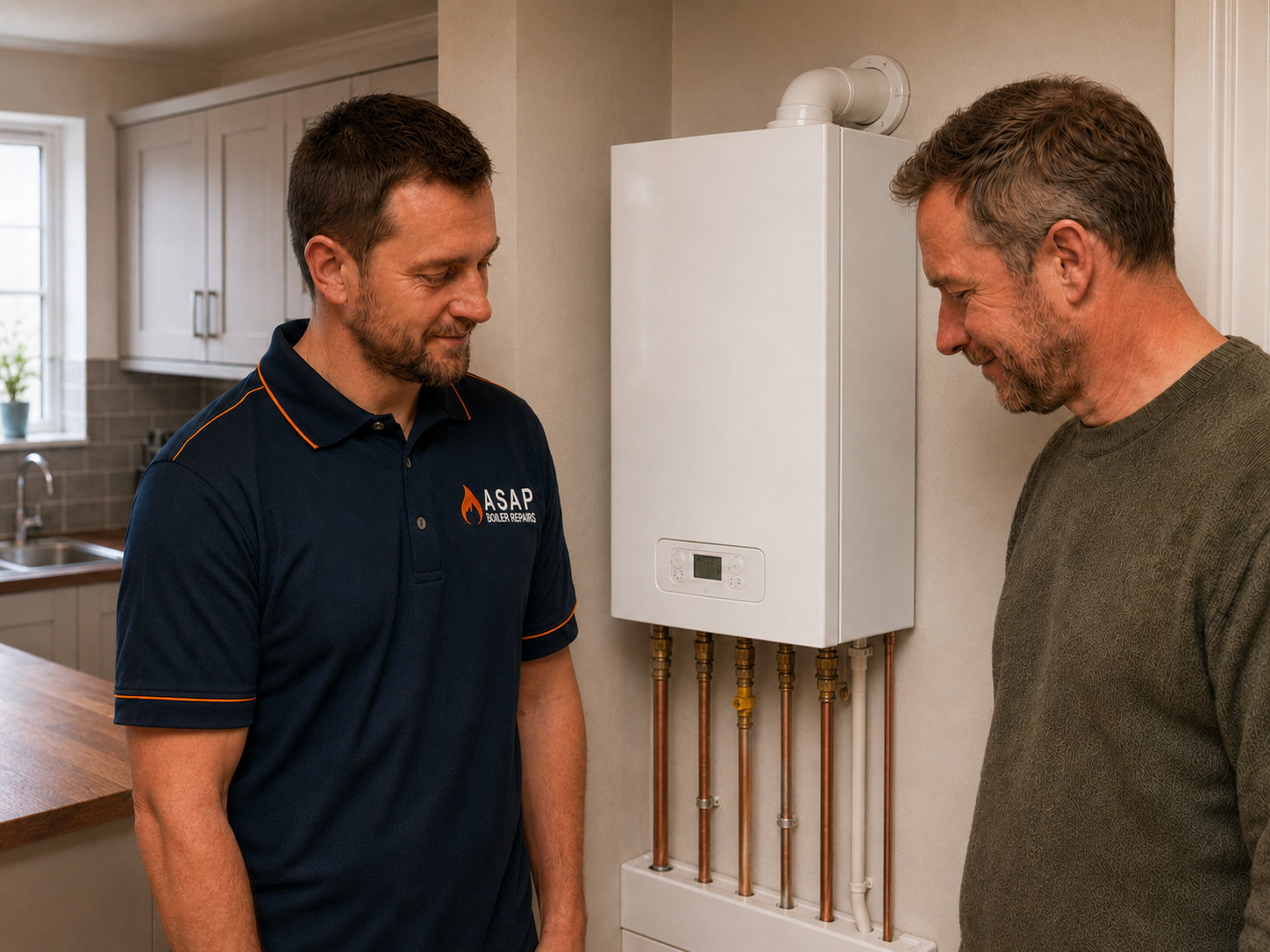
SW1 and W1 are stucco terraces and mansion blocks, and a large share of the flats in them are heated from a communal plant room in the basement rather than by an appliance of their own. What sits in the cupboard is a heat interface unit: a white box with four pipes going into it, no gas supply and no flue.
It is a heat exchanger, not a boiler. Hot water arrives from the building's plant, and the unit takes heat out of it for your radiators and produces your hot water on demand through a plate exchanger. There is nothing to ignite, nothing to lock out, and none of the fault codes you would find on a boiler apply.
What does go wrong is specific to it: the plate exchanger scales up and the hot water goes lukewarm, the actuator on the primary valve fails so the unit stops drawing heat, or the keep-warm function is switched off and hot water takes an age to arrive at the tap. Most domestic heating firms will not attend one, which is why these calls often go unanswered for days.
If your flat has no gas meter and no flue outside, you almost certainly have a heat interface unit rather than a boiler. It also means your heating bill comes through the building rather than from an energy supplier, which is worth knowing before anybody talks to you about a more efficient appliance.
Three different answers, depending on what is in the cupboard.
On a heat interface unit, hot water that has gone lukewarm while the radiators stay fine is the plate exchanger, scaled. It is the same failure a combi has and it is a part rather than a machine. Hot water that takes a long time to arrive is usually the keep-warm setting rather than a fault at all.
On a stored system, the same complaint points at the cylinder side: the motorised valve that diverts flow to the tank, the cylinder thermostat, or the immersion element.
And in a block, a unit that has stopped drawing heat altogether may be doing so because the building's plant is at fault rather than the unit. That is a question for the managing agent, and it is worth establishing before anybody quotes for parts.
An unvented cylinder is a pressurised store, so working on one is notifiable and needs a G3 qualification on top of Gas Safe registration. Plenty of firms hold one and not the other, which is why a cylinder call so often becomes two visits. Our engineers hold both, so it is one visit and one charge. See unvented cylinder repair.
On a heat interface unit it is the whole fault list.
London water comes off the Thames and the Lea, both of which run through chalk. It measures roughly 277 milligrams of calcium carbonate per litre, and that figure is much the same across the city.
Where it lands is what differs. On a heat interface unit it goes straight for the plate exchanger, which is the single part between the building's heat and your shower, so scale shows up as lukewarm water long before anything else complains. On a stored system it coats the coil inside the cylinder instead. Same water, different part.
Age does not decide it. The failed part does.
A pump, a diverter valve, a thermostat or a fan is a repair on almost any appliance, whatever its age. A failed main heat exchanger on a boiler well past ten years is the point where the arithmetic stops working, and we will tell you that rather than sell you the repair.
On a heat interface unit the replacement question rarely reaches you, because the unit belongs to the flat but the plant behind it belongs to the building. A scaled plate exchanger is a part. A unit that never quite works may be sized for a flat that has since been knocked through. Both are worth establishing before anybody proposes replacing anything.
Our boiler replacement page sets out what a replacement actually involves, including what changes when a stored system is converted, and the costs guide explains what moves the figure.
That answer costs nothing. It is the one most people ring us for. Call 0203 868 6134.
Next door to here we cover St John's Wood and Maida Vale and Chelsea and South Kensington. Everything else is on boiler repair in north London and areas we cover.
These are where we work most, not a boundary. An engineer attends anywhere in north London and south London. Tell us where you are and we will say plainly when we can get to you.
No boiler in the cupboard?
If there is a white box with four pipes and no flue, that is a heat interface unit. It is not a boiler and most firms will not touch one. Tell us and we will bring the right engineer.
If you smell gas: do not touch any switches. Open the windows, leave the property, then call the National Gas Emergency Service on 0800 111 999. That line is free and open 24 hours. Call them before you call us.
If a carbon monoxide alarm is sounding: get everyone out immediately, then call 999 if anyone feels unwell. Do not go back in until the property has been ventilated and checked.
If the boiler locks out repeatedly: try one reset. If it locks out again straight away, stop. Repeated resets hide a fault that is still there, and on a gas appliance that is not a risk worth taking.
Under the Gas Safety (Installation and Use) Regulations 1998, only a Gas Safe registered engineer may work on gas appliances. Never open the boiler casing yourself.
Yes. The names listed above are the ones we hear most, and they are nowhere near a complete list. We work right across London, north and south of the river. Ring and tell us the address and you will get a straight answer about timing.
A heat interface unit. Your building has a communal plant room producing hot water, and that box takes heat out of it for your radiators and makes your hot water on demand. It has no gas and no flue, so none of the fault codes you would find on a boiler apply to it.
Usually not. That is the plate exchanger inside it, scaled up, which is the same failure a combi has and is a part rather than a machine. Hot water that arrives slowly rather than lukewarm is usually the keep-warm setting instead, and that is not a fault at all.
It can be either, and it is worth establishing before anybody quotes for parts. If neighbours are affected too, or the unit shows no heat arriving on its primary side, the fault is in the building's plant and belongs to the managing agent rather than to you.
Because it is not a gas appliance, so a Gas Safe qualification alone does not cover the work, and many domestic firms have never been trained on them. It means these calls often sit unanswered for days, which is precisely why we take them.
Yes, and every other major make, including the ones most firms will not touch. Those two and Viessmann are what we open most where a flat or house has its own appliance. Keston appears in basement plant rooms, and Ferroli, Vokera, Biasi, ATAG and Ravenheat turn up in mews houses. If your boiler is showing a code, the brand pages explain it.
Yes, and on the same visit where the appliance passes, so a let property is not off the market twice. See landlord gas safety certificates. If it has no gas supply we cover electric boilers as well.
The line is answered 24 hours a day by a technical customer service member, not a call centre reading from a script. If you have a heat interface unit rather than a boiler, say so when you ring, because it decides which engineer we send rather than whether we come.
Every major make, and the fault code pages often name the part before you ring.
The houses and the flats that do have their own appliance run Worcester Bosch, Vaillant and Viessmann, with Keston appearing in basement plant rooms because of how it can be flued.
We also work on the makes most firms will not: Ferroli, Vokera, Biasi, ATAG and Ravenheat all turn up in mews houses and smaller flats, and parts for every one are still obtainable.
If your boiler is showing a code, the make decides what it means. A heat interface unit shows none of them, which is itself the clue. Each brand page lists the codes for that make and what causes them.
The full list is on our boiler brands page, and general repairs are on boiler repair in London.
Tell us where you are and whether there is a cylinder in an airing cupboard. With those two answers we can usually name the likely part, give you the rate, and book somebody in, all on the one call.
Gas Safe registered. Unvented cylinder qualified. Parts guaranteed for a year. Covering London, north and south of the river, 24 hours a day.