Gas Safe registered

Cold radiators and sludge
Cold at the bottom, black water when you bleed them, a pump that keeps failing. We test the system before quoting, and we will tell you when a flush is not the answer.
Answered 24 hours a day by a technical customer service member.
The standard everyone quotes asks for the system to be cleaned. It does not say the cleaning has to be a machine flush, and that distinction is worth money.
No heating or hot water right now? Call 0203 868 6134. We will tell you the earliest realistic slot rather than the one you want to hear.
Two details to start. Tell us how many radiators and what the bleed water looks like, and we can be specific.

Three steps, and you will know where you stand before an engineer is booked.
We test the water before we quote a flush. A sample and a thermal check take minutes and they settle the question. Quoting a full day's work on a description over the phone is how this job got its reputation, and we are not doing that to you.
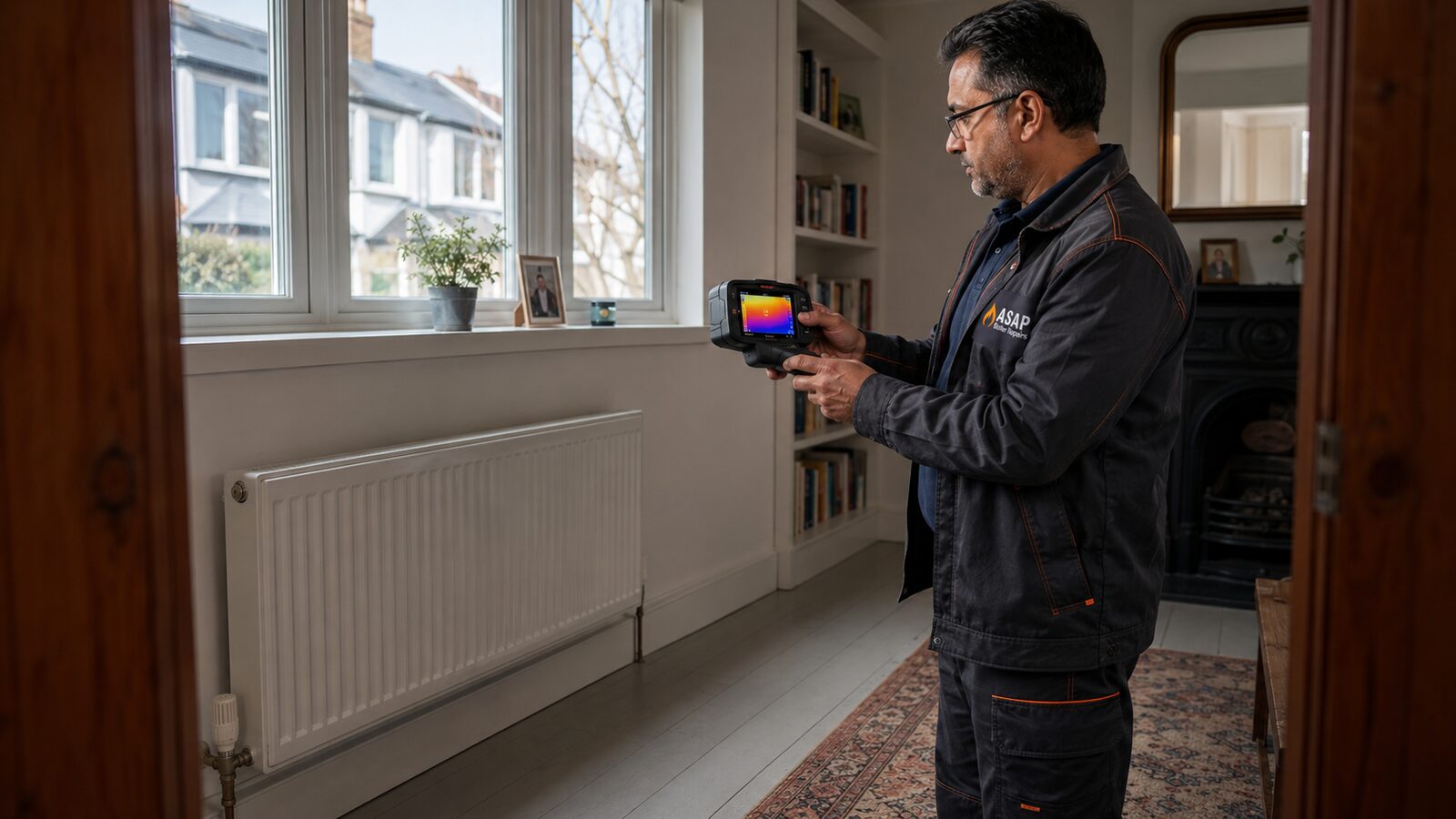
Three of these are real evidence. The rest of what gets quoted for is guesswork.
Steel radiators and system water react and produce magnetite, a black iron oxide sludge. It settles where the water moves slowest and it circulates where the water moves fastest, which is why the symptoms show up at opposite ends of the system.
This is the classic and it is the one worth trusting. Sludge settles in the base of the radiator where flow is slowest, and the water simply goes over the top of it. A hand run down the panel finds the line.
What it is not: air. Air collects at the top, so a radiator cold at the top and warm at the bottom needs bleeding, not flushing. People get this the wrong way round constantly, and it is the difference between a two minute job and a day's work.
The check that settles it: a thermal camera across the panel shows the cold band and how far up it reaches. It takes a minute and it is evidence rather than opinion.
Clear or faintly straw coloured is healthy. Grey or dark is magnetite in suspension. Black, and staining what it lands on, means the system has been corroding for years without protection.
A water sample is the second evidence point and it is worth taking properly rather than by eye. Alongside colour we check the inhibitor level, and the standard sets useful limits: the water should sit between pH 6.5 and 8.5, and dissolved solids above 2000 parts per million point to contamination rather than ordinary wear.
A pump that has been replaced and failed again. A diverter valve that sticks every winter. A plate heat exchanger blocking on a combi so the hot water runs lukewarm. On its own each of those is a repair. Together, or twice in three years, they are a symptom of what is circulating rather than a run of bad luck.
Modern condensing boilers make this worse, not better. Their heat exchangers have far narrower waterways than the cast iron units they replaced, so debris that an old boiler pushed through happily now blocks. That is also why fitting a new boiler onto a dirty system is the expensive mistake.
Replaced the same part twice? Call 0203 868 6134 and tell us which one.
This is the standard every quote refers to. Almost nobody quoting it has read what it requires.
You are probably wondering whether this is one of those jobs that gets sold to everybody who rings. It frequently is, and the reason is a piece of trade shorthand that has drifted a long way from the document behind it.
| What BS 7593:2019 requires | What it does not say |
|---|---|
| The system is cleaned and flushed with fresh water before inhibitor goes in | That the cleaning has to be a machine power flush |
| A permanent in-line filter fitted to every system, capturing magnetic and non-magnetic debris | That a filter on its own replaces cleaning |
| Inhibitor added after cleaning, at the correct concentration, and compatible with aluminium | That any inhibitor suits any boiler |
| The water tested on site every year for inhibitor level and cleanliness | That a flush is a once and never again job |
| Inhibitor re-dosed every five years, or the water fully tested | That topping up occasionally is the same thing |
The sentence that matters: the standard lists power flushing, mains pressure flushing and gravity flushing as acceptable cleaning methods. It asks for a clean system. It does not mandate the machine. A competent chemical clean with a fresh water flush, the right inhibitor and a filter fitted afterwards is compliant, and on a moderately dirty system it is often the proportionate answer.
Same objective, three different levels of intervention, three different days of work.
A cleaner is dosed into the system and circulated by the system's own pump for a period, then the whole lot is flushed out with fresh water, refilled, dosed with inhibitor and a filter fitted.
Right for: a system in reasonable condition. No cold patches, bleed water only slightly discoloured, no repeat part failures. Also the sensible option where a full flush is impractical.
Not right for: a system with established sludge. The system's own pump cannot move enough water to shift what has settled, so you are dosing chemicals into a problem they will not reach.
A pump is connected to the system and moves water at a far higher flow rate than the system's own pump can manage, with the direction reversed repeatedly so debris is lifted rather than pushed further in. Radiators are worked one at a time, and a magnet on the return catches what comes out so there is something to show you at the end.
Right for: established sludge. Cold bands across several radiators, black bleed water, repeat pump or heat exchanger failures. It is a remedial deep clean, not maintenance.
What makes it work faster: the standard specifically notes that external magnetite capture and mechanical vibration of radiators improve cleaning. Both are worth asking about, because a flush without either is slower and less thorough.
How long: most of a working day on a typical London house. Anybody offering to power flush ten radiators in ninety minutes is describing a chemical rinse and calling it something else.
Been quoted for one? Ask what the water test showed before you agree.
Mains water is used to drive the flush rather than a machine. Quicker to set up and effective on lighter fouling, and it is named in the standard as an acceptable method in its own right.
The London caveat: mains pressure varies enormously across the city and top floor flats in particular often do not have enough of it to make this work. It is worth knowing before someone arrives expecting to use it.
Had a quote you are not sure about?
Tell us what you were told and what the symptoms actually are. We will say whether it sounds proportionate, and if a chemical clean would do the same job we will say that too.
Four situations where the money is better spent elsewhere, and one where a flush can make things worse.
None of these is a reason to ignore the system. They are reasons to spend the money on the actual fault. If the diagnosis points at the appliance rather than the pipework, that is gas boiler repair, and our guide to repair costs sets out what drives the figure.
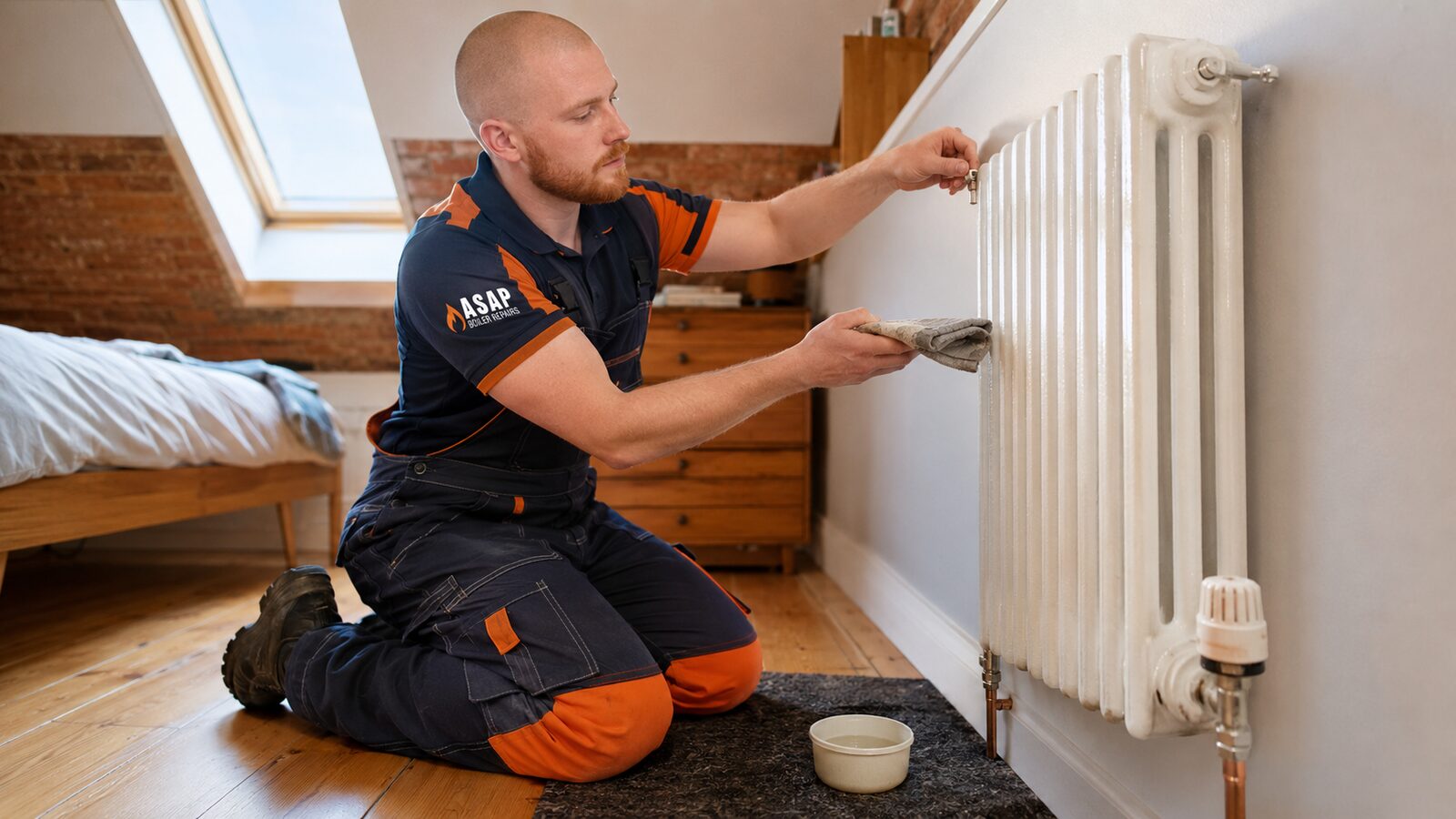
The flush is the part people pay for. The three things after it are what decide whether they pay again in five years.
Inhibitor, at strength and the right type. It coats the metal and holds iron oxide in suspension so the filter can catch it. The type matters more than it used to: most modern condensing boilers have aluminium heat exchangers, and the inhibitor has to be compatible with aluminium as well as copper, brass and steel. A cheap product chosen on price can be the wrong chemistry for the boiler it is protecting.
A permanent in-line filter, on the return, as close to the boiler as it will sit. BS 7593:2019 requires one on every system, which surprises people who assume it is an upsell. Its job is to catch what future corrosion produces, and it only works if somebody empties it. A filter nobody has opened in four years is a full one.
Then the annual check. The standard asks for an on-site water test every year for inhibitor level and cleanliness, and for the inhibitor to be re-dosed every five years or the water fully tested. That is a five minute job inside an annual boiler service and it is the reason some systems never need a second flush.
If a replacement is on the cards, the order of the two jobs is not a detail.
Always clean the system before the new boiler goes on, never after. Fit a boiler to a contaminated system and magnetite circulates through the new heat exchanger from the first firing, in an appliance whose waterways are far narrower than whatever it replaced. That is the failure manufacturers investigate first when a heat exchanger claim arrives, and extended guarantees commonly make cleaning and treatment in line with the standard a condition of cover.
The practical version: take a water sample before any work is agreed. Dark or black water means the system needs cleaning as part of the installation, and it should be in the quote rather than appearing later as an extra. That sits on our boiler installation page.

Local boiler repair specialists
Clear advice. Careful repairs. Family-friendly service.
Call 0203 868 6134London, north and south of the river. These are the districts we work in most.
These are where we work most, not a boundary. An engineer attends anywhere in north London and south London. Tell us where you are and we will say plainly when we can get to you.
If you smell gas: do not touch any switches. Open the windows, leave the property, then call the National Gas Emergency Service on 0800 111 999. That line is free and open 24 hours. Call them before you call us.
If a carbon monoxide alarm is sounding: get everyone out immediately, then call 999 if anyone feels unwell. Do not go back in until the property has been ventilated and checked.
If the boiler locks out repeatedly: try one reset. If it locks out again straight away, stop. Repeated resets hide a fault that is still there, and on a gas appliance that is not a risk worth taking.
Under the Gas Safety (Installation and Use) Regulations 1998, only a Gas Safe registered engineer may work on gas appliances. Never open the boiler casing yourself.
No. This is the most widely repeated wrong answer in the trade. BS 7593:2019 requires the system to be cleaned and flushed with fresh water before inhibitor is added, and it lists power flushing, mains pressure flushing and gravity flushing as acceptable methods. A competent chemical clean, the right inhibitor and a permanent in-line filter is compliant. Power flushing is one legitimate method, not the only one, and which is appropriate depends on how fouled the system actually is.
Three pieces of evidence, and you can check two yourself. Radiators cold across the bottom while hot at the top, which is sludge settling where flow is slowest. Water that runs grey or black when you bleed one, rather than clear or faintly straw coloured. And the same component failing twice, typically a pump, a diverter valve or a combi plate heat exchanger. One of those on its own is worth investigating. All three together is a fouled system.
No, that is air, and it needs bleeding rather than flushing. Sludge settles, so it makes a radiator cold at the bottom. Air rises, so it makes one cold at the top. People reverse these two constantly and it is the difference between a two minute job and a full day's work. If you bleed it and the air comes back within weeks, something is drawing air into the system and that is worth looking at properly.
Most of a working day on a typical London house, because each radiator is worked individually and the water is reversed repeatedly to lift debris rather than push it further in. Anybody offering to do ten radiators in ninety minutes is carrying out a chemical rinse and describing it as a power flush. The standard also notes that external magnetite capture and mechanical vibration of the radiators improve the result, and both add time for a reason.
Not on its own, and it is not meant to. BS 7593:2019 requires a permanent in-line filter on every system, but its job is to catch what future corrosion produces, not to remove sludge that has already settled in the radiators. Fitting a filter to a badly fouled system is closing the gate afterwards. Clean first, then fit the filter, then dose the inhibitor, and empty the filter at every service, because one nobody has opened in four years is simply full.
It can, and this is worth saying out loud. On a very old system with thin, heavily corroded radiators and joints undisturbed for decades, moving that volume of debris at pressure can find every weak point at once, and leaks appear that the sludge was effectively holding closed. Where that is the picture we will tell you before starting, and the honest conversation is usually about replacing radiators rather than cleaning them. A gentler chemical clean is often the right compromise.
Always before. Fit a boiler to a contaminated system and magnetite circulates through the new heat exchanger from the first firing, and modern condensing boilers have far narrower waterways than the units they replace. It is also a warranty question: extended guarantees commonly make cleaning and treatment in line with the standard a condition of cover, and the state of the system water is among the first things a manufacturer investigates when a heat exchanger claim arrives. Take a water sample before the installation is agreed.
London, north and south of the river, across twenty six districts. Chiswick and Bedford Park, Balham and Wandsworth Common, and Coulsdon are three of them. We do not qualify coverage by distance or add conditions to particular postcodes, and we take landlord and managing agent work alongside our landlord gas safety certificate visits. The full list is on our areas we cover page.
Sludge damages some heat exchangers faster than others, and the inhibitor has to suit the metal. These pages set out the codes and the parts that fail on each.
Every make is listed on the boiler makes we repair. If the heating has failed completely rather than run cold, that is emergency boiler repair. If you would rather write than ring, contact a boiler engineer in London.
Have the number of radiators, the colour of the bleed water and whether a filter is fitted ready if you can. With those three we can usually tell you which method your system actually needs before anybody is booked in.
Gas Safe registered. Unvented cylinder qualified. Parts guaranteed for a year. Covering London, north and south of the river, 24 hours a day.