Gas Safe registered

Biasi specialists

Riva Plus, Riva Compact, Inovia and the 24S. Twenty years on Biasi boilers, rates agreed beforehand, and parts guaranteed for a year.
Answered 24 hours a day by a technical customer service member.
On a Biasi the suffix matters. A plus means the boiler is still running, a Reset means it has locked out.
No heating or hot water right now? Call 0203 868 6134. We will tell you the earliest realistic slot rather than the one you want to hear.
Two details to start. Add the fault code and your postcode and we can usually tell you the likely part before we attend.
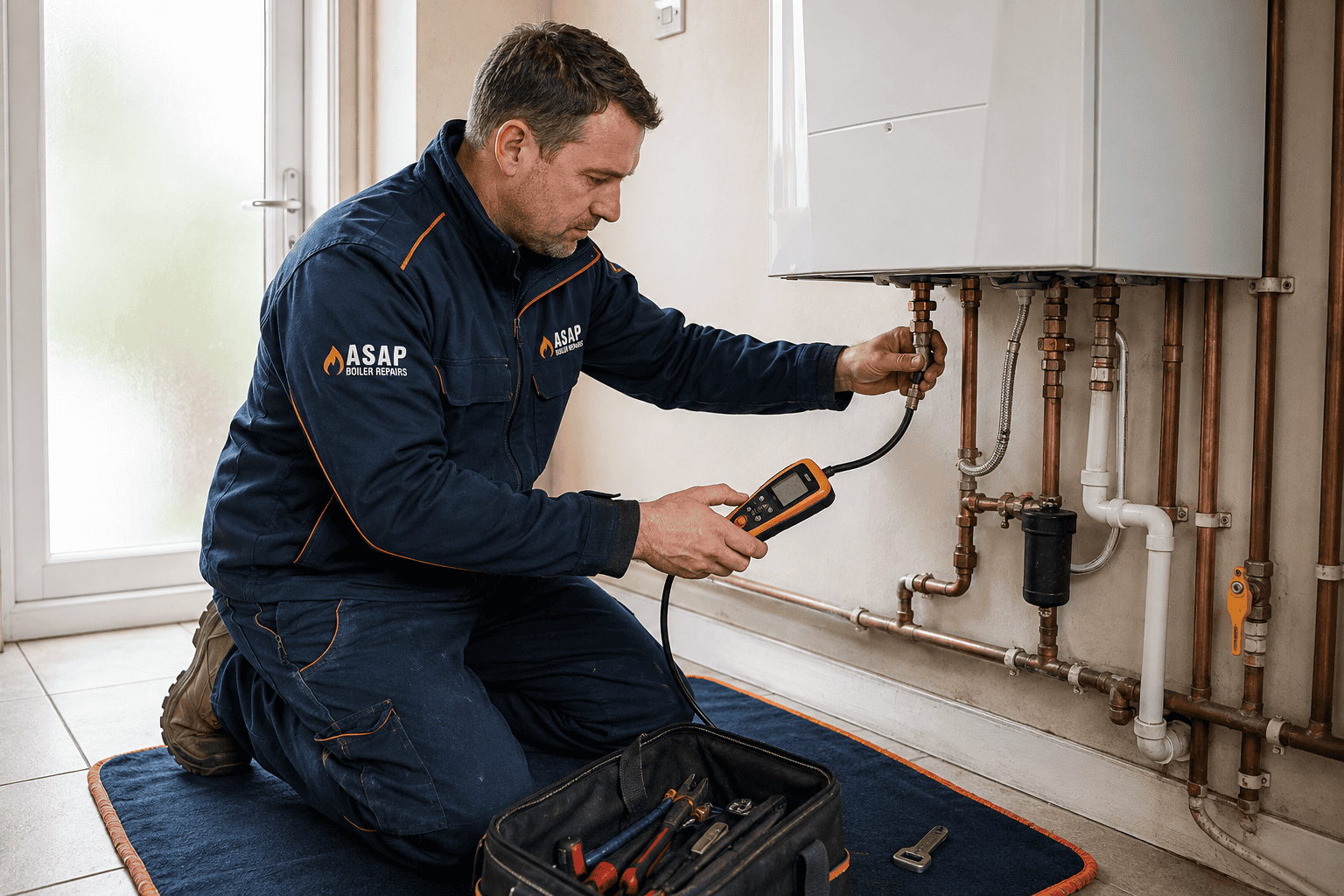
Three steps, no sales pitch, and you will know where you stand before an engineer is booked.
If a Biasi fault comes back a fortnight after somebody fixed it, that is worth pursuing rather than paying for twice. A repeat visit usually means an intermittent fault such as loose wiring, or a second problem missed on the first attendance. Most firms, ourselves included, carry a call-out warranty of around thirty days, so ask for the follow up under the original job rather than booking a new one.
Biasi have been fitted across London in large numbers in the budget and mid range, so the failure pattern is well mapped and the parts are easy to get. Six cover most of it.
Most makes give you a code and leave you to work out whether the boiler has stopped. Biasi tells you outright. The characters after the number say whether the appliance is still running or has locked out, and that is the first thing to read.
What the boiler is saying: pressure has dropped below what it needs to run safely. Of every code on this page, this is the one most likely to be resolved without an engineer.
What you can safely do: repressurise the system through the filling loop until the gauge reads between 1 and 1.5 bar cold, close both valves firmly, then reset once.
On newer firmware the same fault appears as E118 instead, which is why searching for one code finds nothing about the other.
If the gauge reads a healthy 1.2 bar and the code is still showing, the pressure sensor has failed rather than the pressure. Small part, short job.
Has it dropped again since you last filled it? That answer is the diagnosis.
The boiler ran its ignition sequence several times, never detected a flame and locked out. It is the most common Biasi fault, and on other firmware the identical problem reads as A01 or E133.
Check the gas first. Try a gas hob or fire. If those will not light either, top up a prepayment meter or call your supplier, because no gas anywhere is not a boiler fault.
Then the isolation valve. There is usually a gas isolation valve under or beside the boiler. The handle should be in line with the pipe. It is a genuinely common find after anybody has worked nearby.
In winter, the condensate pipe. Find the white plastic pipe leaving the wall and pour lukewarm water over the frozen section until it runs freely, then reset once. Lagging it afterwards stops it recurring.
What an engineer will do: clean or replace the ignition electrode, or test the gas valve. Those are two very different jobs and testing is what separates them.
Does the hob light? Ten seconds, and it changes the answer entirely.
The water went past the limit the safety thermostat allows and the boiler locked out. On newer firmware the same fault appears as A02 or E110.
Nine times in ten: circulation rather than the burner. A jammed pump, a seized valve, sludge or trapped air, all of which leave the boiler making heat faster than the system carries it away.
What to stop suspecting: the safety thermostat, which is the part reporting the problem rather than causing it. Replace only that and it trips again within days.
Why this one is different from ER 01 and ER 03: those two are worth one reset once the gas has been confirmed. ER 02 is a lockout that should have a Gas Safe engineer look at it before anybody resets it, because something stopped the water moving.
What helps most: not a part. Getting the system properly clean deals with the cause where a component swap usually does not.
Leave it off to cool and tell us whether any radiator was cold beforehand.
Closely related to ER 01 and often appearing alongside it. The boiler has a problem with the flame signal rather than with the initial spark.
The one thing worth doing yourself: confirm the gas supply, then reset once. ER 01 and ER 03 are the two Biasi codes where a single reset is a reasonable first step once you know gas is reaching the property.
What it usually is if the reset does not hold: the flame sensing electrode and its lead, gas pressure that sags once the boiler is drawing properly, or combustion products finding their way back into the air intake.
What to stop suspecting: worth spending money on parts before the gas pressure has been measured at the appliance while it is running.
One reset only. If it locks out again straight away, stop. Repeated resets wear the ignition components while hiding the fault underneath.
Did one reset hold, or did it come straight back?
This is the most useful thing to know about a Biasi and it is missing from almost every code list online.
A code with a plus symbol means an error condition exists and the boiler is still operational. Something is wrong, the appliance is telling you about it, and you still have heating while it gets sorted.
A code followed by Reset means the boiler has entered lockout. It has stopped and will not restart until somebody clears it manually.
Why that changes what you do: a plus is a call you can make on Monday morning. A Reset is a boiler that is off right now. Same number, entirely different situation, and the suffix is the only thing telling them apart.
What to do with it: read us the whole thing, suffix included. It is the difference between us booking you for tomorrow and us treating it as an emergency, and getting that wrong in either direction wastes your time.
Plus, or Reset? That one character decides how we handle it.
FL and Li are status indicators rather than component faults. They report a pressure or temperature condition, which means nothing inside the boiler has necessarily failed.
FL is the one you are most likely to see, and it points at system pressure being too high rather than too low. That usually means somebody overfilled it, or a filling loop has been left open.
What you can safely do: bleed a radiator to release the excess until the gauge sits between 1 and 1.5 bar cold. That is within a householder's scope and it is often the entire fix.
Check the filling loop while you are there. If both valves are not fully closed the pressure climbs again and you will be back to bleeding radiators every week.
If it keeps rising with the loop properly shut, the expansion vessel or the pressure relief valve needs attention, and that is engineer work.
Is the gauge above 2.5 bar? Bleed a radiator before anything else.
If your Biasi shows E133, E110 or E118 rather than ER codes, you have newer firmware, generally on the Inovia and Advance Plus ranges.
The underlying faults are the same. E133 is ignition failure, so read it as ER 01. E110 is the safety thermostat, so read it as ER 02. E118 is low pressure, so read it as ER 04.
Why this matters: a Biasi owner searching for E133 finds guidance written for a completely different manufacturer, because that number is used elsewhere in the industry too. Searching for ER 01 finds Biasi advice. Same boiler, same fault, two very different sets of results.
What to do: give us the code and the range name together. That combination removes the ambiguity in one step.
ER or E? That tells us which firmware you are on.
| Code | What the boiler is saying | What it usually turns out to be |
|---|---|---|
| ER 01 + Reset | Ignition lockout | Gas supply first, then the electrode |
| ER 02 + Reset | Safety thermostat tripped | Circulation. Engineer before resetting |
| ER 03 | Flame signal problem | Sensing electrode or gas pressure |
| ER 04 | Low system pressure | Usually a householder fix. Refill and reset |
| ER 14 | Lockout | Engineer inspection before any reset |
| ER 69 | Lockout | Engineer inspection before any reset |
| FL | System pressure too high | Bleed a radiator, check the filling loop |
| Li | Temperature condition | A status rather than a failed part |
| E133 / E110 / E118 | Newer firmware equivalents | Read as ER 01, ER 02 and ER 04 |
Resetting the boiler and repressurising the system are normal user actions and do not affect your guarantee. Plenty of people leave a boiler off for days because they are afraid that touching it will void the cover, and that is not how it works. What would put a guarantee at risk is opening sealed components or anything carrying gas, which is engineer territory and not something a householder should be doing anyway. Topping up the pressure is not.
Several of the Biasi calls we take are not about the boiler, and one of the most common did not exist ten years ago.
This is a growing share of the no-heating calls we attend, and on a Biasi it is worth ruling out before anybody opens the boiler.
Nest, Hive, Tado and their relatives replace the old programmer and room thermostat, and they can be wired several different ways depending on the installation. Get that wiring wrong and the boiler either will not fire at all or throws a communication error, while being in perfect health itself.
The clue: timing. If the problem started within days of a new thermostat going in, or after a battery change, or after somebody redecorated near the wiring, that is where to look.
What to try: put the control into a constant or manual override, or turn the heating on at the boiler itself if your model allows it. If the boiler fires, the problem is upstream and the repair is far smaller than you feared.
What we do: ask about controls before we quote for parts. Replacing a board on a boiler that was never being asked to run is an expensive way to change nothing.
Has anything changed with the thermostat recently? Call 0203 868 6134.
Somebody attended, changed a part, the heating worked, and now the identical code is back. This is frustrating and it is also usually explainable.
The two common causes: an intermittent fault, typically loose wiring or a board that fails only when warm, which behaves perfectly during a visit. Or a second problem that was masked by the first and only surfaced once the original was cleared.
What you should do about it: ask for a follow up under the original call-out warranty rather than booking a fresh job. Most firms give around thirty days, ourselves included, and a genuine repeat of the same fault inside that window is what the warranty is for.
What helps the second engineer: the date and time it recurred, whether the boiler was hot or cold, and what the code was. An intermittent fault is found by pattern rather than by inspection.
What not to accept: a second bill for the same diagnosis without anybody explaining why the first repair did not hold.
Everybody knows about pressure dropping. Pressure rising catches people out, and on a Biasi it shows as FL rather than as a numbered fault.
The two usual causes: a filling loop that has not been fully closed, so the system slowly takes on mains water, or an expansion vessel that has lost its air charge and can no longer absorb the expansion when the water heats.
How to tell them apart: a loop left open raises the pressure whether the heating is on or off. A failed vessel shows a normal reading cold and an alarming one hot, then drops back as the system cools.
What you can safely do: check both filling loop valves are fully closed, then bleed a radiator to bring the pressure back to between 1 and 1.5 bar cold.
Why it matters: pressure climbing past the relief valve setting pushes water out through the discharge pipe, and a system that keeps losing and regaining water is a system quietly filling itself with sludge.
Does the gauge read differently hot and cold? That is the diagnosis. Call 0203 868 6134.
Biasi is Italian, sits in the budget and mid range, and gets treated by some as an unfamiliar badge. That shows up in quotes as long lead times and inflated parts prices.
The reality: Biasi parts are widely stocked through the main national merchants, and the common items, pumps, boards, sensors and electrodes, are generally available quickly.
What to ask if you get a long lead time: which part specifically, and which supplier was checked. A genuine availability problem names both. A vague answer about the brand being obscure is not a diagnosis.
Where it is genuinely true: the oldest ranges, where a discontinued board or a bespoke heat exchanger can end a repair. We will tell you when you have reached that point rather than after you have paid for a diagnosis.
Back a fortnight later? Do not pay twice
A repeat of the same fault usually means loose wiring, a board that misbehaves only when warm, or a second problem masked by the first. Most firms carry a call-out warranty of around thirty days, ourselves included.
The label is behind the front panel. On this make the range name tells you which of two code systems your boiler uses.
Biasi name the range, then the output, then letters for the type. A Riva Plus 24S is a Riva Plus rated 24 kilowatts.
If your model is a system boiler, there is stored hot water somewhere in the property and the cylinder is as likely to be the fault as the boiler is.
Riva Plus, Riva Compact, Garda and the 24S and 28S use the ER code system with the plus and Reset suffixes described above.
Inovia and Advance Plus use the newer E codes, E133, E110 and E118, which map onto the same underlying faults.
Riva Advance sits between the two and its service documentation uses the E format with a plus, which is a hybrid worth knowing about before you look anything up.
The quickest test without a label: if your display shows ER followed by a space and two digits, you are on the older system. If it shows E followed by three digits, you are on the newer one.
Biasi have revised ranges and firmware repeatedly, and the same range name can carry either code system depending on when yours was made.
The serial number, the GC number and the M reference on the label identify exactly which appliance is on your wall, and they are what a merchant matches against when ordering a part.
Snap the whole label before you pick the phone up. On this brand it also settles the firmware question in one step, which is the difference between us quoting confidently and us guessing. We work on every make of boiler and the same advice holds for all of them.
London is a hard water city almost everywhere, and that is the single biggest difference between repairing a Biasi here and repairing one in Manchester or Glasgow.
The supply comes off the Thames and the Lea, both of which run through chalk in the Chilterns and the North Downs. London water measures roughly 277 milligrams of calcium carbonate per litre, and across the city's postcode districts the figure runs from about 250 to over 350. Inside a combi that has one consequence: the plate heat exchanger furs up, and it does it faster than the service intervals in the manual assume.
It is the same story in Islington and Highbury as it is in Coulsdon. The water is hard, the plate heat exchanger scales, and the only question is whether anybody checks it before condemning the boiler.
Hardness is not uniform, and it does not follow borough boundaries. It varies by supply zone and can change over a short distance, so your supplier publishes a figure for your own postcode and it is worth reading before anybody guesses.
Scale drops out of solution faster the hotter the water gets. A combi set to deliver taps at 65 degrees furs up its plate heat exchanger noticeably faster than one set to 50, which is still hot enough to scald. Turning that dial down costs nothing and is the most effective thing a householder in a hard water area can do. This applies to the tap setting, not to a cylinder, which must reach 60 degrees for safety.
Larger London houses keep stored hot water, and a combi cannot replace it however good the badge is.
Combi-only is the norm among London firms, and in a city full of large period houses that leaves a lot uncovered. A Biasi system or heat only boiler runs a separate cylinder with its own thermostat, immersion element and, if unvented, its own safety devices. So the commonest wrong call-out on this arrangement is the hot water going, the boiler getting blamed, and the boiler turning out to be in perfect health.
The cylinder sensor sits in a pocket on the tank and tells the boiler what the stored water is doing. When it fails, or simply works its way out of that pocket, the boiler stops heating the cylinder while the radiators carry on perfectly, which is exactly why the appliance gets blamed.
The motorised valve decides whether the boiler is heating radiators, the cylinder, or both. A failed motor or microswitch gives you one without the other, and on most installations the head changes without draining the system down.
The immersion element scales and either trips its thermostat or stops heating. Worth testing before anybody condemns a tank, because an element costs a fraction of one. Large houses on stored hot water, of the kind we see across Balham and Wandsworth Common, often have a scale reducer fitted at the same visit.
Because an unvented cylinder holds mains pressure, it carries a set of safety devices: an expansion vessel, a pressure reducing valve, an expansion relief valve and a temperature and pressure relief valve, all discharging through a tundish. Water at the tundish is the system reporting that one has failed, and capping it is never the answer.
That work is notifiable and requires G3 as well as Gas Safe registration. We hold both, so the appliance and the cylinder are diagnosed on the same visit rather than across two. It is why our unvented cylinder repair is not farmed out to somebody else.
Removing a cylinder to reclaim an airing cupboard is the decision we are asked to undo more than any other. However large the output figure, a combi heats water as it passes rather than storing it, so it cannot serve two showers at once. With three bathrooms the right answer is almost always to keep stored hot water, and to replace an ageing cylinder rather than lose it.

Selling you a boiler you do not need is not the business we want. What decides this is which part has gone, not how old the appliance is.
| What has failed | Under 8 years | 8 to 14 years | 15 years and older |
|---|---|---|---|
| Pressure sensor, temperature sensors | Repair | Repair | Repair if parts exist |
| Ignition and sensing electrodes | Repair | Repair | Repair if parts exist |
| Expansion vessel, pump | Repair | Repair | Repair |
| Fan | Repair | Repair | Depends on the rest of the boiler |
| Diverter valve, plate heat exchanger | Repair | Repair | Repair if the part is still made |
| Gas valve | Repair | Depends on the rest of the boiler | Replace |
| Control board | Check the guarantee first | Borderline, we will be straight with you | Replace |
| Main heat exchanger | Guarantee claim if registered | Usually replace | Replace |
Every component is still made, and at this age you are looking at one failed part, not a tired boiler. An electrode, sensor, pump or fan on a six year old Riva or Inovia is a repair, without qualification.
Ask about the guarantee position when you ring, ours included. Biasi registered guarantees run for a set term from installation. Resetting the boiler and topping up the pressure do not affect it, whatever anybody has told you.
If somebody quotes you for a new boiler at this age, ask which single part has failed and what that part costs on its own. The gap between those two answers is usually the whole conversation.
Still a clear repair: electrodes, sensors, pump, fan, expansion vessel, diverter valve. Ordinary wear items that say nothing about the condition of the rest of the boiler.
The part that decides it on this brand: the control board. It is the most expensive component in most Biasi boilers, and on a mid range appliance past ten years old a genuine board failure is where replacement starts to win.
Before accepting a board quote: ask what was tested first. A failed sensor feeding the board nonsense, water on a connector or a chafed harness all produce board-shaped symptoms, and replacing the board changes nothing if one of those is the real fault.
Past this point availability takes over from cost. The common wear parts are still widely stocked for this brand, which helps, but a discontinued board or a bespoke heat exchanger on an old range can end a repair regardless.
Where the part does still exist, an older Biasi is often worth keeping. These are straightforward boilers and plenty have run for two decades on nothing but an annual service.
We will establish whether the part is still made before you pay for any diagnosis. That question is free. Our repair and replacement cost guide explains what the figure is actually built from.

Local boiler repair specialists
Clear advice. Careful repairs. Family-friendly service.
Call 0203 868 6134London, north and south of the river. These are the districts we work in most.
These are where we work most, not a boundary. An engineer attends anywhere in north London and south London. Tell us where you are and we will say plainly when we can get to you.
If you smell gas: do not touch any switches. Open the windows, leave the property, then call the National Gas Emergency Service on 0800 111 999. That line is free and open 24 hours. Call them before you call us.
If a carbon monoxide alarm is sounding: get everyone out immediately, then call 999 if anyone feels unwell. Do not go back in until the property has been ventilated and checked.
If the boiler locks out repeatedly: try one reset. If it locks out again straight away, stop. Repeated resets hide a fault that is still there, and on a gas appliance that is not a risk worth taking.
Under the Gas Safety (Installation and Use) Regulations 1998, only a Gas Safe registered engineer may work on gas appliances. Never open the boiler casing yourself.
It tells you whether the boiler has stopped. An ER code shown with a plus symbol means an error condition exists but the appliance is still operational, so you have heating while it gets sorted. The same code followed by the word Reset means the boiler has entered lockout and will not restart until somebody clears it manually. Same number, entirely different situation, so read us the whole thing including the suffix because it decides how urgently we treat it.
Usually, yes. ER 04 means system pressure has dropped below what the boiler needs to run safely, and of every Biasi code it is the one most likely to be resolved without an engineer. Repressurise through the filling loop until the gauge reads between 1 and 1.5 bar cold, close both valves firmly and reset once. On newer firmware the same fault shows as E118. If it drops again within days there is a leak, and topping up repeatedly fills the system with sludge.
No. Resetting the boiler and repressurising the system are normal user actions and do not affect the guarantee. People leave boilers off for days over this and it is not how the cover works. What would put a guarantee at risk is opening sealed components or anything carrying gas, which is engineer territory and not something a householder should be attempting anyway. Topping up the pressure through the filling loop is not in that category.
ER 01 is an ignition lockout, meaning the boiler failed to detect a flame after several attempts. On newer firmware the identical fault reads as E133, and on some models as A01. Check the gas first by trying a hob, then check the gas isolation valve beside the boiler is open with the handle in line with the pipe. In winter check the white condensate pipe outside for ice and thaw it with lukewarm water. Otherwise it is usually the ignition electrode or the gas valve.
FL is a status indicator rather than a component fault, and it points at system pressure being too high rather than too low. Usually somebody has overfilled the system or a filling loop has been left open. Bleed a radiator to release the excess until the gauge sits between 1 and 1.5 bar cold, and check both filling loop valves are fully closed while you are there. If the pressure keeps climbing with the loop properly shut, the expansion vessel or the relief valve needs an engineer.
Ask for a follow up under the original call-out warranty rather than booking a fresh job, because most firms give around thirty days and a genuine repeat of the same fault inside that window is exactly what it is for. The usual causes are an intermittent fault such as loose wiring or a board that only misbehaves when warm, or a second problem that was masked by the first. Note the date, the time and whether the boiler was hot or cold, because intermittent faults are found by pattern.
Not for the common items. Biasi parts are widely stocked through the main national merchants, and pumps, boards, sensors and electrodes are generally available quickly. If you have been quoted a long lead time, ask which part specifically and which supplier was checked, because a genuine availability problem names both while a vague answer about the brand being unfamiliar does not. Real scarcity applies mainly to the oldest ranges and discontinued boards.
There is no flat rate, because there is no flat fault. What a repair costs follows from what has broken, and that has to be established first. Three variables, and only three: the component, whether it has to be ordered in, and how long the work runs. On a Biasi the suffix tells us whether the boiler has stopped, which decides whether this is an emergency visit or a booked one. The rate is agreed beforehand and parts we fit are guaranteed for a year, so nothing is carried out on the assumption that you will approve it afterwards. There is no charge for telling you a repair is not the right call. Our repair and replacement cost guide explains what the figure is actually built from.
Biasi is one of the few makes that tells you in the code itself whether the boiler has locked out or is still running, which is a genuinely useful habit the rest of the industry has not copied.
No gas supply? Plenty of London flats run without one, and we also cover electric boiler repair.
If the same Biasi fault has come back, claim it on the original call-out rather than paying again. Read us the whole code including the plus or the word Reset, and the range name from the label.
Gas Safe registered. Unvented cylinder qualified. Parts guaranteed for a year. Covering London, north and south of the river, 24 hours a day.