Gas Safe registered

CR5
Gas Safe engineers across CR5, 24 hours a day.
Answered 24 hours a day by a technical customer service member.
A boiler that keeps firing and stopping is usually too big for the system, not broken.
No heating or hot water right now? Call 0203 868 6134. We will tell you the earliest realistic slot rather than the one you want to hear.
Two details to start. Add your postcode and whether there is a cylinder in an airing cupboard and we can usually tell you the likely part before we attend.

We cover Coulsdon, and the whole of London
Tell us the address and you will get an honest answer about timing.
View areas we coverThree steps. The first one usually tells us most of it.
If a repair is not worth doing, we will say so on the phone. Call 0203 868 6134.
Almost nobody says they live in CR5. They say Old Coulsdon, or Chipstead Valley, or Coulsdon South.
Names we hear on CR5 calls, and the postcodes around it
Grouped by postcode, because that is the one part of an address everybody knows.
We work right across London, north and south of the river. If yours is not here, ring and tell us the address.
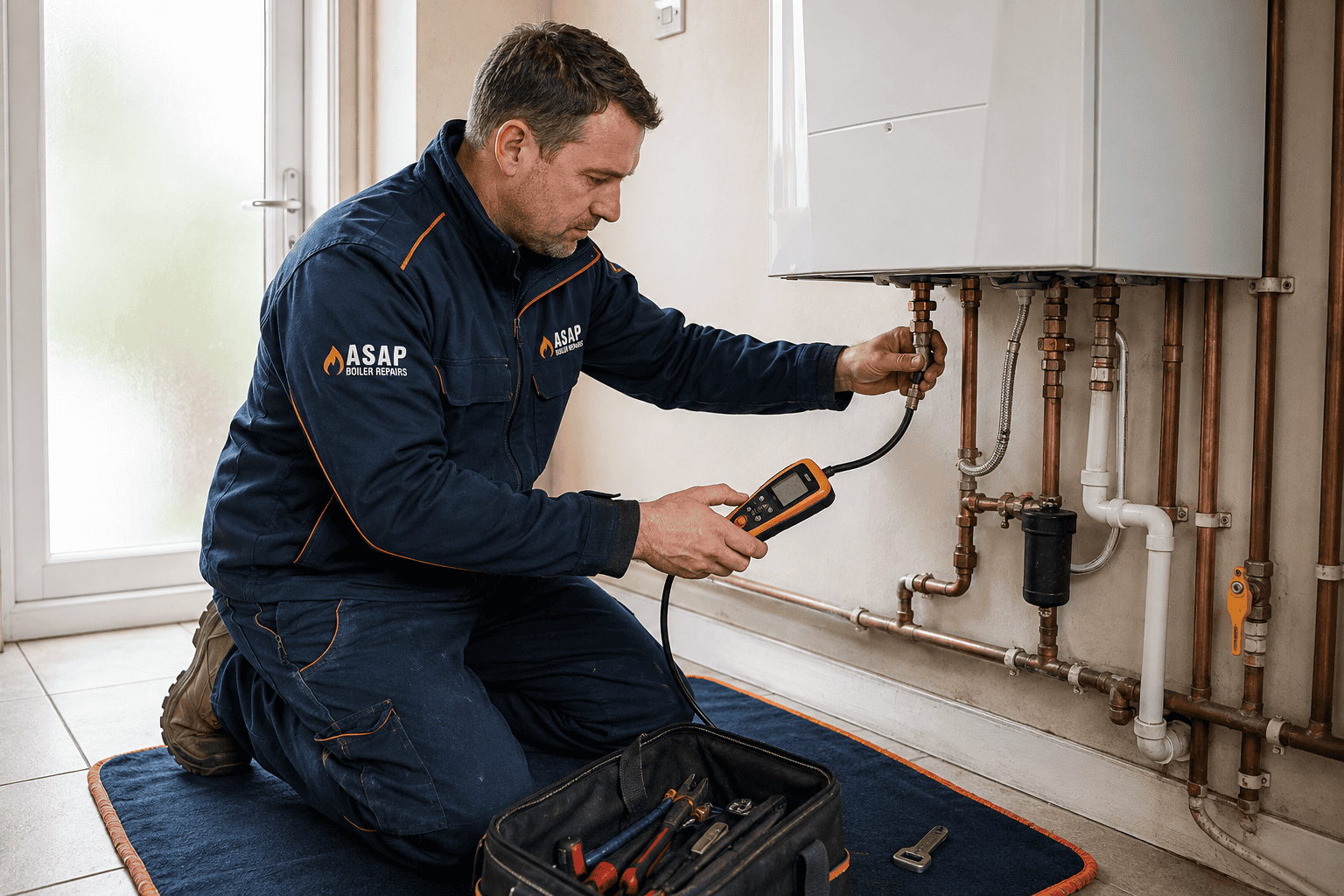
And a great many houses here have one.
CR5 is interwar and postwar semis and detached houses of moderate size, and over the last twenty years most of them have had a combi fitted. When those went in, bigger was very often assumed to be safer, so the appliance chosen produces far more heat than the radiators in the house can absorb.
That produces short cycling. The boiler fires, satisfies the system within a few minutes because there is nowhere for the heat to go, shuts down, and fires again shortly afterwards. Every one of those starts costs a little wear on the ignition, the fan and the heat exchanger, and every one of them burns gas at the least efficient moment in the cycle.
It is not a breakdown, which is why it goes unreported for years and then presents as a boiler that has failed early. It is usually correctable without replacing anything: turning the maximum output down to match the house, setting a lower flow temperature so the boiler condenses properly, and making sure the controls are not calling for short bursts of heat all day.
Most combis can be turned down. A boiler rated at 30 kilowatts in a house that needs 12 will run better, last longer and cost less to run at a lower setting, and the adjustment is made in the appliance rather than bought.
The commonest call from CR5, and it is rarely the boiler.
On a combi, hot water that has gone lukewarm and unpredictable while the heating stays perfect is the plate heat exchanger, furred with scale. It is a part, it costs a fraction of an appliance, and it is the commonest repair we carry out.
Where a cylinder survives, the same complaint points at the cylinder side: the motorised valve that diverts flow to the tank, the cylinder thermostat, or the immersion element. A boiler that has been short cycling for years will also have worn its diverter valve harder than a well matched one, which is worth knowing before it is blamed on age.
An unvented cylinder is a pressurised store, so working on one is notifiable and needs a G3 qualification on top of Gas Safe registration. Plenty of firms hold one and not the other, which is why a cylinder call so often becomes two visits. Our engineers hold both, so it is one visit and one charge. See unvented cylinder repair.
Look it up rather than take anybody's word for it.
Most of London drinks water drawn from the Thames and the Lea and treated by Thames Water, and it measures roughly 277 milligrams of calcium carbonate per litre. This corner of the city is one of the places where that is not the supplier. Much of it takes its water from SES Water instead, drawn from chalk boreholes rather than from a river.
Scale does the same thing wherever it comes from. In a combi it furs the plate heat exchanger and the hot water goes lukewarm. A boiler that short cycles makes that worse, because scale forms fastest at the hottest surfaces and a boiler firing hard in short bursts spends a great deal of its life exactly there.

Age does not decide it. The failed part does.
A pump, a diverter valve, a thermostat or a fan is a repair on almost any appliance, whatever its age. A failed main heat exchanger on a boiler well past ten years is the point where the arithmetic stops working, and we will tell you that rather than sell you the repair.
If a boiler has been short cycling for years it will have aged faster than its date suggests, and that is a genuine reason to look at replacing it. What matters is not repeating the mistake. The replacement should be sized against what the house actually needs rather than against what the last one was, and in most of these houses that is a smaller number than people expect.
Our boiler replacement page sets out what a replacement actually involves, including what changes when a stored system is converted, and the costs guide explains what moves the figure.
That answer costs nothing. It is the one most people ring us for. Call 0203 868 6134.
Next door to here we cover Purley and Kenley and Epsom and Ewell. Everything else is on boiler repair in south London and areas we cover.
These are where we work most, not a boundary. An engineer attends anywhere in north London and south London. Tell us where you are and we will say plainly when we can get to you.
Boiler always going on and off?
If it fires for a few minutes, stops, and starts again a few minutes later, it is short cycling. That wears parts out and costs money, and it is a settings and sizing problem rather than a breakdown.
If you smell gas: do not touch any switches. Open the windows, leave the property, then call the National Gas Emergency Service on 0800 111 999. That line is free and open 24 hours. Call them before you call us.
If a carbon monoxide alarm is sounding: get everyone out immediately, then call 999 if anyone feels unwell. Do not go back in until the property has been ventilated and checked.
If the boiler locks out repeatedly: try one reset. If it locks out again straight away, stop. Repeated resets hide a fault that is still there, and on a gas appliance that is not a risk worth taking.
Under the Gas Safety (Installation and Use) Regulations 1998, only a Gas Safe registered engineer may work on gas appliances. Never open the boiler casing yourself.
Yes. The names listed above are the ones we hear most, and they are nowhere near a complete list. We work right across London, north and south of the river. Ring and tell us the address and you will get a straight answer about timing.
Probably not. That is short cycling, and it usually means the appliance produces more heat than the radiators can absorb, so it satisfies the system almost immediately and shuts down. It is not a breakdown, but every start wears the ignition, the fan and the heat exchanger, so it is worth correcting.
Usually yes. Most combis can have their maximum output turned down to match the house, and setting a lower flow temperature makes the boiler condense properly instead of firing hard and stopping. The adjustment is made inside the appliance rather than bought.
Because a combi's size is often chosen for how much hot water it can deliver at the tap rather than how much heat the house needs, and bigger feels safer. The result is an appliance well matched to the shower and badly matched to the radiators.
Almost certainly not. On a combi that is the plate heat exchanger, furred with scale so the boiler cannot get heat across into the water fast enough. Flushing or replacing it costs a fraction of an appliance.
Yes, and every other major make. Those two and Baxi are what we open most in CR5, with Glow-worm and Potterton on the installations they replaced and Viessmann and Alpha turning up as well. If your boiler is showing a fault code, the brand pages explain what it means for your make.
Yes, and on the same visit where the appliance passes, so a let property is not off the market twice. See landlord gas safety certificates. If it has no gas supply we cover electric boilers as well.
The line is answered 24 hours a day by a technical customer service member, not a call centre reading from a script. In the middle of the night we will tell you honestly whether it is a tonight job or a first thing in the morning job.
Every major make, and the fault code pages often name the part before you ring.
These houses mostly run combis, and the ones we open most here are Worcester Bosch, Ideal and Baxi, with Glow-worm and Potterton common on the installations they replaced. Viessmann and Alpha both turn up as well.
Every one of them can be turned down, and the setting is in the appliance rather than something to be bought. What differs is where the adjustment lives and what the manufacturer calls it, which is one reason the make matters.
If your boiler is showing a code, the make decides what it means. A Worcester Bosch EA and an Ideal L2 are different faults with different fixes, and neither of them on its own means a new boiler. Each brand page lists the codes for that make and what actually causes them.
The full list is on our boiler brands page, and general repairs are on boiler repair in London.
Tell us where you are and whether there is a cylinder in an airing cupboard. With those two answers we can usually name the likely part, give you the rate, and book somebody in, all on the one call.
Gas Safe registered. Unvented cylinder qualified. Parts guaranteed for a year. Covering London, north and south of the river, 24 hours a day.