Gas Safe registered

N20 NW7
Gas Safe and G3 qualified engineers across N20 and NW7, 24 hours a day.
Answered 24 hours a day by a technical customer service member.
Some of the larger houses here run a thermal store rather than a cylinder, and it fails in a completely different way.
No heating or hot water right now? Call 0203 868 6134. We will tell you the earliest realistic slot rather than the one you want to hear.
Two details to start. Add your postcode and whether there is a cylinder in an airing cupboard and we can usually tell you the likely part before we attend.

We cover Totteridge, and the whole of London
Tell us the address and you will get an honest answer about timing.
View areas we coverThree steps. The first one usually tells us most of it.
If a repair is not worth doing, we will say so on the phone. Call 0203 868 6134.
Almost nobody says they live in N20. They say Totteridge Village, or Whetstone, or Oakleigh Park.
Names we hear on N20 and NW7 calls, and the postcodes around them
Grouped by postcode, because that is the one part of an address everybody knows.
We work right across London, north and south of the river. If yours is not here, ring and tell us the address.
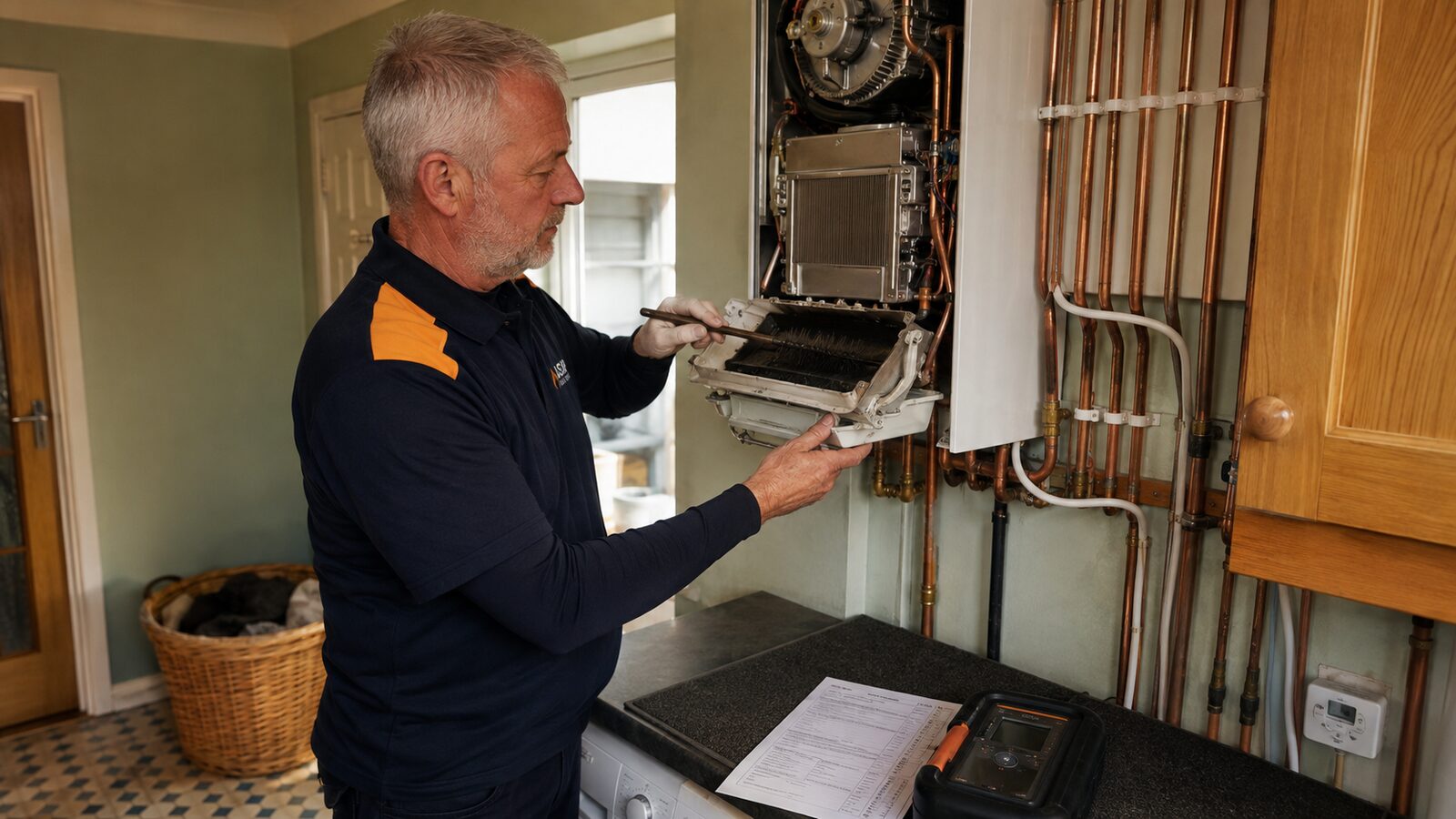
Which is a different appliance with a different fault list.
N20 and NW7 hold some of the largest detached housing on our list, on big plots, and a good number of them were fitted with a thermal store rather than an ordinary hot water cylinder. It is worth knowing which you have, because the two look much the same in a cupboard and behave in opposite ways.
A cylinder stores your hot water and heats it with a coil. A thermal store does the reverse. It holds a large volume of heated central heating water, and your mains water passes through a coil inside it and comes out hot on demand. Nothing you wash in is ever stored, which is why a thermal store needs no G3 certification and cannot legionella in the way a cylinder can.
The consequences are practical. A thermal store gives mains pressure hot water without an unvented cylinder's safety components, so there is no expansion vessel and no tundish to go wrong. But it is only as good as its coil and its stratification, so a scaled coil or a badly plumbed return produces hot water that starts well and fades within a minute. That symptom on a cylinder means something else entirely.
If the pipe from your cold mains goes into the top of the vessel, it is a cylinder. If it goes into a coil and comes straight back out to the taps while the vessel itself connects to the boiler and radiators, it is a thermal store. Two minutes with a torch settles it and it changes the whole diagnosis.
On a store that is the coil. On a cylinder it is something else.
On an ordinary stored system, heating that works and hot water that does not points at the cylinder side: the motorised valve that diverts flow to the tank, the cylinder thermostat, or the immersion element. Each costs a fraction of a new appliance.
On a thermal store the same complaint means something different. Hot water that runs well for a minute and then goes lukewarm is the coil failing to pick up heat fast enough, either because it has scaled or because the store itself is not holding temperature. Nothing is wrong with the boiler and nothing is wrong with the taps.
Establishing which appliance you have before anybody attends is the difference between a diagnosis and a guess, and it costs nothing on the phone.
An unvented cylinder is a pressurised store, so working on one is notifiable and needs a G3 qualification on top of Gas Safe registration. Plenty of firms hold one and not the other, which is why a cylinder call so often becomes two visits. Our engineers hold both, so it is one visit and one charge. See unvented cylinder repair.
On a thermal store it goes straight for the coil.
London water comes off the Thames and the Lea, both of which run through chalk. It measures roughly 277 milligrams of calcium carbonate per litre, and that figure is much the same across the city.
Where it lands is what differs. In a combi it furs the plate heat exchanger. On a cylinder it coats the coil that heats the water. On a thermal store it coats a coil that is doing all the work at once, because that coil is producing your hot water on demand rather than warming a tank slowly, so scale shows up as a fading shower long before it shows anywhere else.
Age does not decide it. The failed part does.
A pump, a diverter valve, a thermostat or a fan is a repair on almost any appliance, whatever its age. A failed main heat exchanger on a boiler well past ten years is the point where the arithmetic stops working, and we will tell you that rather than sell you the repair.
On a thermal store the replacement conversation is usually about the store rather than the boiler, and they have very different service lives. A store with a scaled coil can be descaled or its coil replaced, which is a fraction of the cost of converting the whole house to an unvented cylinder, and the conversion brings safety components a store does not need.
Our boiler replacement page sets out what a replacement actually involves, including what changes when a stored system is converted, and the costs guide explains what moves the figure.
That answer costs nothing. It is the one most people ring us for. Call 0203 868 6134.
Next door to here we cover Hampstead Garden Suburb and Finchley and Highgate, Muswell Hill and Crouch End. Everything else is on boiler repair in north London and areas we cover.
These are where we work most, not a boundary. An engineer attends anywhere in north London and south London. Tell us where you are and we will say plainly when we can get to you.
Cylinder, or thermal store?
They look alike in a cupboard and they fail for opposite reasons. Tell us whether there is a big insulated vessel with pipework on top and we can usually say which you have.
If you smell gas: do not touch any switches. Open the windows, leave the property, then call the National Gas Emergency Service on 0800 111 999. That line is free and open 24 hours. Call them before you call us.
If a carbon monoxide alarm is sounding: get everyone out immediately, then call 999 if anyone feels unwell. Do not go back in until the property has been ventilated and checked.
If the boiler locks out repeatedly: try one reset. If it locks out again straight away, stop. Repeated resets hide a fault that is still there, and on a gas appliance that is not a risk worth taking.
Under the Gas Safety (Installation and Use) Regulations 1998, only a Gas Safe registered engineer may work on gas appliances. Never open the boiler casing yourself.
Yes. The names listed above are the ones we hear most, and they are nowhere near a complete list. We work right across London, north and south of the river. Ring and tell us the address and you will get a straight answer about timing.
Follow the cold mains pipe. If it goes into the top of the vessel, you have a cylinder storing your hot water. If it goes into a coil and straight back out to the taps, while the vessel itself connects to the boiler and the radiators, you have a thermal store. Two minutes with a torch settles it.
On a thermal store that is the coil, either scaled or not picking up heat fast enough from the store. It is not the boiler and it is not the shower. On a cylinder the same symptom means something different, which is why knowing which you have matters before anybody attends.
No. A thermal store holds heating water rather than your hot water, so it does not need the expansion vessel, tundish and thermal cut-out an unvented cylinder carries, and G3 certification does not apply to it. That is one of its advantages and it is why the fault list is shorter.
Almost certainly not. On a cylinder that points at the motorised valve, the cylinder thermostat or the immersion element. On a thermal store it points at the store not holding temperature. Our unvented cylinder repair page explains the cylinder side.
Yes, and every other major make, including the ones most firms will not touch. Those two and Viessmann are what we open most in N20 and NW7. Ariston, Ferroli, Vokera, Biasi, ATAG and Keston turn up on second appliances serving annexes and garden rooms. If your boiler is showing a fault code, the brand pages explain what it means.
Yes, and on the same visit where the appliance passes, so a let property is not off the market twice. See landlord gas safety certificates. If it has no gas supply we cover electric boilers as well.
The line is answered 24 hours a day by a technical customer service member, not a call centre reading from a script. In the middle of the night we will tell you honestly whether it is a tonight job or a first thing in the morning job.
Every major make, and the fault code pages often name the part before you ring.
Houses this size run system boilers, and here that is mostly Worcester Bosch, Vaillant and Viessmann, with Ideal common on anything replaced in the last decade.
We also work on the makes most firms will not: Ariston, Ferroli, Vokera, Biasi, ATAG and Keston all turn up here, often on a second appliance serving an annexe or a garden room. Parts for every one of them are still obtainable.
If your boiler is showing a code, the make decides what it means. A Vaillant F75 and a Worcester Bosch EA are different faults with different fixes. Each brand page lists the codes for that make and what causes them.
The full list is on our boiler brands page, and general repairs are on boiler repair in London.
Tell us where you are and whether there is a cylinder in an airing cupboard. With those two answers we can usually name the likely part, give you the rate, and book somebody in, all on the one call.
Gas Safe registered. Unvented cylinder qualified. Parts guaranteed for a year. Covering London, north and south of the river, 24 hours a day.