4.6 Google reviews
Open 24 hours, 7 days Rates agreed before we start Gas Safe registered
Gas Safe registered

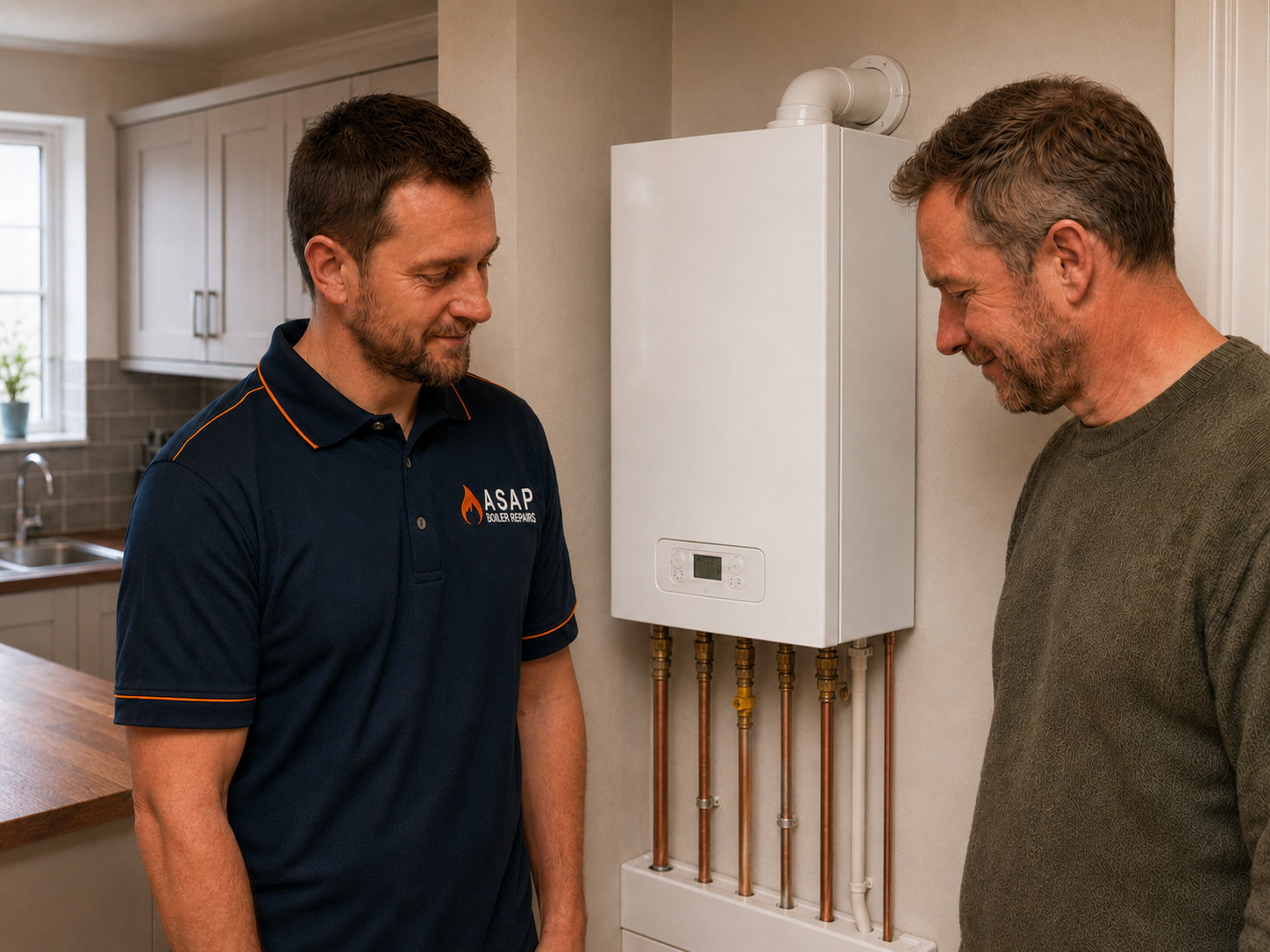
ASAP Boiler Repairs engineer greeting homeowner

Electric boiler repairs

Electric Boiler Repair, London

Amptec, Electromax, Mattira, Fusion Comet and the Aztec. Twenty years on wet heating systems, the rate agreed before anyone starts work, and parts guaranteed for a year.

Call 0203 868 6134

Answered 24 hours a day by a technical customer service member.

Almost every code an electric boiler can show is about one of three things: water flow, water temperature or the electrical supply.

  • Gas Safe registered engineers
  • An engineer as soon as we can, booked around you
  • Cylinder and unvented systems as well as combis
  • Parts guaranteed for a year, rates agreed before work starts
No heating or hot water right now? Call 0203 868 6134. We will tell you the earliest realistic slot rather than the one you want to hear.
Google Reviews
  • "He was very professional tidy and polite. Would recommend!"

    Anna M.

  • "Very professional and would recommend to anyone!"

    Abby M.

  • "These guys provide an excellent service. A pleasure to deal with and professional"

    Day Walker

Prefer we call you? Request a call back

Two details to start. Add the make and your postcode and we can usually tell you the likely part before we attend.
No obligation. If you have a cylinder we tell you whether it is the boiler or the cylinder before any work is agreed.

We use your details only to respond to your enquiry. See our privacy policy.

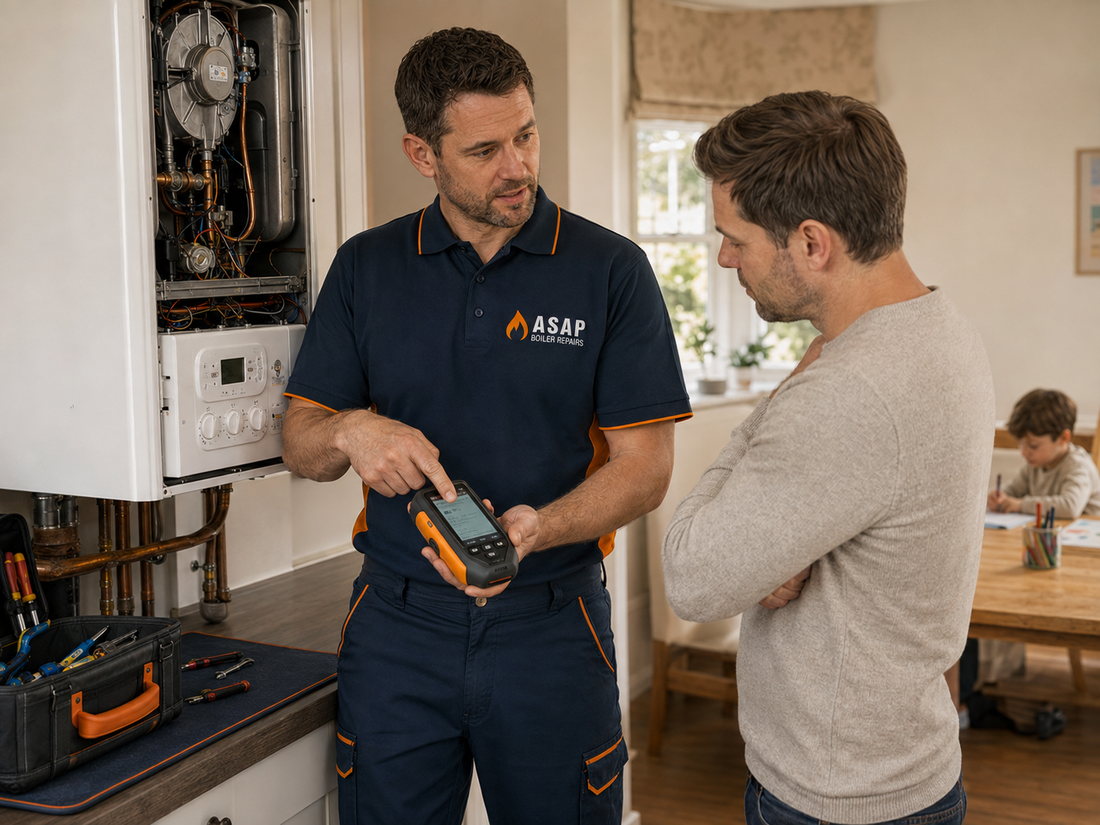
ASAP Boiler Repairs engineer explaining a boiler diagnosis to a homeowner

What happens when you call

Three steps, and you will know where you stand before an engineer is booked.
  1. Tell us the make and what the lights are doingAmptec, Electromax, Aztec, Mattira, Fusion Comet or something else, and whether the display is lit, flashing or dark. Say whether you have a cylinder or a store, because that changes which half we are looking at.
  2. The likely part, and a realistic slotWe tell you the likely part and a realistic slot. If we cannot reach you today we say so on the phone, rather than after you have waited in.
  3. The engineer attends and runs a full diagnosticYou get a written breakdown before any repair begins: what has failed, what the parts and labour come to, whether the part is on the van or has to be ordered, and roughly how long the work will take. Nothing goes ahead until you have seen that and agreed to it. Parts are guaranteed for a year.

If it is not worth repairing, we will tell you on the phone rather than after we have charged you to attend. A heat exchanger shell that has corroded through on a fifteen year old electric boiler is a replacement conversation, and pretending otherwise helps nobody.

Electric boiler fault codes and warning lights, and what they actually mean

Every maker uses its own code set, but they all report the same shortlist: water flow, water temperature, pressure and the electrical supply. Every lockout below is one of those four wearing a different number.
Flow

Not enough water moving through the boiler

What the boiler is saying: a flow switch has decided too little water is passing through, so it cut the elements before they could boil what was standing in front of them. On an Elnur Mattira that is E3, on an EHC Fusion Comet the pump indicator flashes, on a Trianco Aztec it is F6. The numbers that matter: a Mattira needs 7 litres a minute, a Fusion Comet drops into fault below 5, and an Aztec asks for 8 at 6kW rising to 12 at 12kW. These are low water content boilers, so the margin is small. What it usually is: thermostatic valves closed on every radiator with no automatic bypass, then a seized pump, then air, then magnetite in the flow switch. What it usually is not: the elements. They are the expensive part and they get replaced for this far more often than they deserve. Why it comes back: the boiler goes back on the same system that starved it. A system flush and a working bypass fix the cause where a new flow switch clears only the symptom.

Locking out once the radiators are warm? That is the classic flow fault.

Bar

Low pressure, or a pressure sensor that has stopped reading

An electric boiler on a sealed system wants the same 1 to 1.5 bar cold as any other. A Fusion Comet flashes its pressure indicator below roughly 0.5 bar, an Aztec shows F4, a Mattira asks to be refilled to 1.5 bar. None of those is a boiler fault. The boiler is reporting the system, not itself. What you can safely do: top up through the filling loop to between 1 and 1.5 bar cold, then disconnect the loop. This is one of the few electric boiler faults a householder can clear.
  • Once or twice a year: normal. Systems lose a little water.
  • Every few weeks: a leak, often a radiator valve or a pinhole under a floor.
  • Every few days: the expansion vessel has lost its charge and is pushing water out of the relief pipe on every heating cycle.
The detail nobody mentions: the vessel inside these boilers is small. A Fusion Comet carries 6 litres and is rated for a system holding roughly 60 litres. Put one on a house with fifteen radiators and it discharges at the safety valve every winter until a second vessel goes in.

Reading below 1 bar cold? Call 0203 868 6134 and tell us how often you are topping it up.

Trip

Overheat lockout, and the reset that is not on the front panel

Every electric boiler carries a high limit safety thermostat behind the working one. A Mattira trips at 100 degrees, or 80 if it was set up for underfloor heating. An Aztec runs at about 75 and its limit is factory set at 95. Once tripped, it stays tripped. Where the reset lives: not on the display. On a Mattira it is a pin under a black screw cap on the underside of the boiler, and it will not click back until the water drops below the trip temperature. On an Aztec, F1 clears by holding the time key for six seconds once the fault is fixed. What it usually is: circulation, not the heat source. These boilers hold two to three litres of water, so when flow stops the temperature climbs in seconds. What it usually is not: something to keep resetting. A limit thermostat that trips twice is telling you the fault underneath it is still there.

Resetting it more than once a week? Stop and let us look at the circulation.

RCD

The breaker keeps tripping and the boiler is dead

This fault has no code, because the boiler loses its supply before it can display one. Trianco list it plainly: if the earth leakage device has tripped, the screen does not light up at all. What it usually is: a heating element that has failed to earth. Heatrae Sadia's fault chart for the Amptec sends you straight there and gives the figures: roughly 19 ohms terminal to terminal, and more than 2 megohms of insulation between terminal and case. An element that has broken down internally fails the second test while still passing the first. The other candidate: water where it should not be. A Trianco Aztec shows E2 for current leakage and names condensation inside the case, which is what boilers boxed into an unventilated cupboard produce. What it usually is not: a faulty RCD. Replacing the device is an expensive way to carry on tripping, and the device was doing its job. What not to do: keep pushing the breaker back up. If it trips again straight away, leave it off. That is what emergency boiler repair is for.

Tripping the moment the heating calls? Tell us which device drops out.

Red

Red alarm light on a Heatrae Sadia Amptec

The Amptec has no display, only lights, and it says four different things with two lamps.
Lamp What it means What it usually turns out to be
Alarm, flashing red No water detected A system that has emptied or lost pressure. Switch off before refilling
Alarm, steady red Thermistor fault The plug at the board more often than the thermistor itself
Call, flashing red Over temperature switch Flow through the boiler the wrong way round, or a loose connection
Call, steady red The 100 degree control has tripped A thermistor sitting loose on the heat exchanger, then the control board
Two things worth knowing: a green call lamp flashing for two or three minutes on start-up is the self test, not a fault. And there is no reset button. Clearing an Amptec alarm means switching the supply off, correcting the fault, then switching it back on, in that order.

Tell us which lamp and whether it is flashing or steady. Call 0203 868 6134.

Off

No display, no lights, nothing at all

Three things do this, and only one of them is a broken boiler.
  • The supply has gone, at the breaker, the local isolator or a blown internal fuse. The Amptec carries a small time delay fuse for its pump circuit, and a short on the pump wiring takes it out.
  • A safety device has cut the supply, either the earth leakage device or a dry burning cut-out that isolates the boiler rather than showing a code.
  • The display has lost the board. An Aztec shows EC for exactly this, and it is normally the ribbon plug rather than either component.
What it usually is not: a dead control board. Boards do fail, but they are the last thing to suspect.

Check whether anything else on that circuit has power, then call 0203 868 6134.

Did you know An EHC Fusion Comet has a magnetic filter built into the boiler, and the manual requires it to be cleaned at least once a year. Let it block and the boiler can shut down, and the maker does not cover that visit under warranty. Most owners have never been told the filter is in there, which is why we look at it before anything else on that make.

Got a light or a code showing?

Read out the make, the kW rating on the data plate and what the lights are doing. On an electric boiler those three answers usually separate a flow fault from an element fault before anybody is booked in.
Call 0203 868 6134
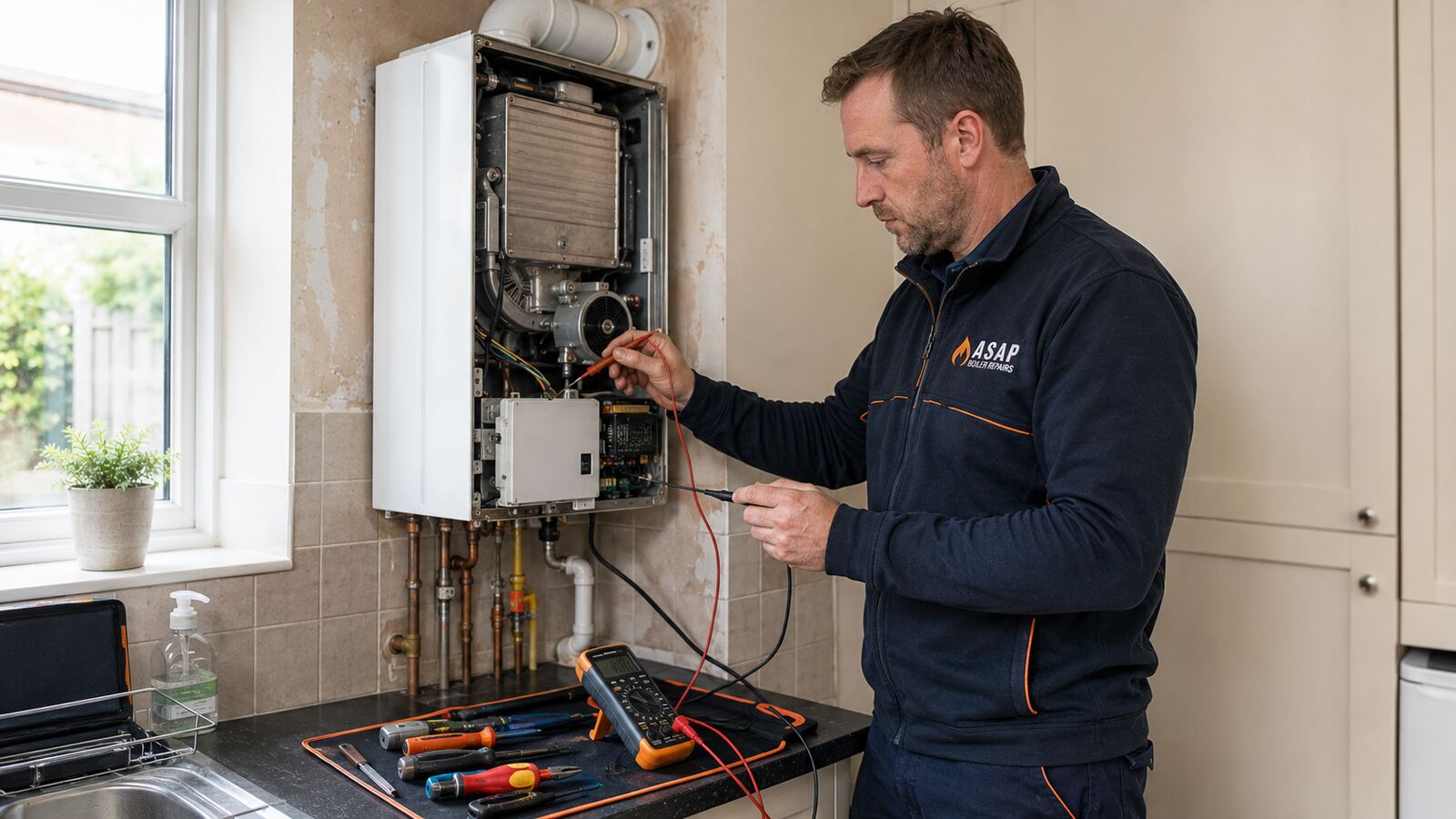
ASAP Boiler Repairs engineer completing a boiler diagnostic check

Which make have you got, and what it is known for

Four makes cover most electric boilers in London homes. Each reports faults differently, and each has a weakness worth knowing before anybody is booked.
The data plate is on the side or inside the front cover, and carries the model, the serial and the output in kilowatts. When you ring, read us the make and that kW rating if you can see it. The rating decides the protective device and the cable feeding the boiler, and a fair share of the faults we attend are supply faults, not appliance faults.

Heatrae Sadia, the Amptec and the Electromax

The Amptec is the wet flow boiler, sold as a C series and a U series, and the series sets the temperature range: the C runs roughly 65 to 80 degrees, the U roughly 30 to 60. It reports with lamps rather than a display. The Electromax is that boiler and a direct unvented cylinder in one case, so it carries two expansion vessels at different pressures and a boost immersion on top. Known for: the control board. A pump that will not run is worth testing at the board before the pump itself is condemned.

Elnur Gabarron, the Mattira

Sold as MAS system models and a MAC combi with a 50 litre store built in. It has a proper digital display and short codes: E1 and E2 are the flow and return probes, E3 is the flow switch, E8 is an outdoor sensor that on most installations was never fitted in the first place. Worth knowing: it leaves the factory at maximum output and is meant to be turned down at commissioning to suit the supply, and on a standard single phase connection it is capped at 12kW however it is set. The pump carries its own lamp, which is the fastest check on it: red flashing is a blocked rotor, green and red together means the supply voltage has drifted outside 180 to 253 volts.

EHC, the Fusion Comet

Runs 6 to 14.4kW on a single phase supply and up to 38.7kW on three phase. It labels its indicators with letters rather than numbers, which catches people out. A is pressure, the pump indicator is flow, K and L are the inlet and outlet sensors, and a flashing call indicator means the volt free control link is open rather than that anything inside the boiler has failed. Worth knowing: standby runs the pump for fifteen minutes every day to stop the system silting up. Switching it off at the wall over summer instead of leaving it in standby is what seizes the pump, and it is the most avoidable call we get on this make.

Trianco, the Aztec Classic

Comes in 6, 9, 11 and 12kW and holds only 2.1 to 3.2 litres of water, which is why flow matters more on this one than on any of the others. Its codes split into two sets. E2 is current leakage, E3 a temperature sensor, E9 antifreeze, EC a display that has lost the board. F1 is dry fire, F4 low pressure, F6 no flow. Once the fault is fixed, the code clears with the confirm key. Worth knowing: the current Aztec Classic is not a like for like swap for the original. It uses volt free switching, so an older installation often needs a relay adding, and a boiler that ignores its controls after a swap is usually that.

The fault that never shows a code

Every code on this page describes something the boiler noticed. This one it cannot see at all, and it is the reason control boards get replaced that did not need to be.

The boiler carries on running after everything is satisfied

The room and cylinder thermostats are both off and the boiler is still making heat. It reads like a stuck relay or a failed board, and it is usually neither. What it usually is: leakage current through a motorised valve holding the control input alive. Heatrae Sadia name this in the Amptec instructions and give the cure, a small capacitor across the control connector. It is minutes of work, and it is the sort of thing that gets a control board condemned instead.

Boiler running with everything switched off? Call 0203 868 6134 and say what valves you have.

The electrical side, and why it matters who attends

This is the part of an electric boiler that most heating firms will not look at, and it is where a real share of the faults live.
These are among the largest fixed loads in a house. The figures below are the ones the makers publish for single phase models.
Output Typical supply current Typical protective device Minimum cable
6kW About 25 to 26 amps 32 amps 4 to 6 square millimetres
9kW About 39 amps 40 to 50 amps 6 to 10 square millimetres
11kW About 45 amps 50 amps 10 square millimetres
12kW About 51 to 52 amps 63 amps 16 square millimetres
Read those against the main fuse for the property. A 12kW boiler and a 9kW electric shower drawing at once is what takes the main fuse out, and the boiler gets blamed because it is the thing that went off. EHC recommend a shower sensor to interrupt the boiler while the shower runs. It is a load calculation, not a guess.
What the manuals ask for: a dedicated circuit, a 30 milliamp double pole earth leakage device, a local isolating switch within reach of the boiler, and a boiler circuit kept separate from the rest of the house.
Where the fault sits in the fixed wiring or at the consumer unit rather than in the appliance, that is notifiable work under Part P of the Building Regulations and belongs to a registered electrician who can certify it. We will say so plainly rather than working around it, which is how we have worked for twenty years.
Did you know Every domestic electric boiler on sale carries an energy label of class D, and none of them is a poor appliance. Almost all of the electricity going in leaves as heat in the water. The label applies a conversion factor to electricity before the figure is printed, which is why a device that wastes almost nothing scores about 36 per cent. It is a fuel comparison, not a verdict on the boiler on your wall.

Hard water, and what it does to an electric system

London is a hard water city almost everywhere, and on an electric system the damage lands somewhere different from a combi.
The supply comes off the Thames and the Lea, both of which run through chalk in the Chilterns and the North Downs. London water measures roughly 277 milligrams of calcium carbonate per litre, and across the city's postcode districts the figure runs from about 250 to over 350. The heating circuit is sealed, so it scales once and stops. The hot water side takes fresh mains water every time a tap opens, and that is where the scale keeps arriving. That distinction decides which part fails. On a boiler feeding a separate cylinder the scale lands on the immersion heater and the cylinder, not on the boiler. On a combined unit with a direct store the elements sit in the stored water and scale directly, which is more expensive. It is the same story in Wimbledon as in Croydon. Hardness is not uniform and does not follow borough boundaries, so your supplier publishes a figure for your own postcode and it is worth reading before anybody guesses.
Did you know Elnur guarantee the Mattira for five years, then exclude the heating elements from any claim for damage caused by scale. In a city running at roughly 277 milligrams per litre that is the sentence in the warranty worth reading. A scale reducer on the incoming main costs a fraction of the element it protects, and almost nobody is told to fit one.
Two problems, two parts: a scale reducer on the mains protects the hot water side, a magnetic filter on the return catches magnetite. Neither does the other one's job, and on an electric system both matter more because the boiler has no spare output to push through a fouled system. Both go in at a yearly service.
ASAP Boiler Repairs engineer checking heating controls in a family home

Electric boilers with a cylinder, and unvented systems

Most firms working on electric boilers stop at the appliance. The hot water half is where the awkward faults are.
An electric boiler is often paired with stored hot water, either a separate cylinder or a store built into the same case. That is a second appliance, with its own thermostat, immersion element and safety devices. The most common wrong call-out runs like this: the hot water has gone, the boiler gets blamed, and the boiler is in perfect health.

The immersion heater cut-out under the cap, and what it is telling you

Immersion heaters carry a combined thermostat and thermal cut-out, and the cut-out sits under a small cap with a pin that pops out when it trips. Pushing it back takes a second, which is exactly why it gets pushed back repeatedly. One that trips regularly is reporting a fault underneath it, and on a pressurised vessel that is not something to keep overriding. Test the element before anybody condemns a cylinder.

Water at the tundish, and the two vessels people confuse

An unvented cylinder carries an expansion vessel, a pressure reducing valve, an expansion relief valve and a temperature and pressure relief valve, all discharging through a tundish. Water running there is the system telling you one of them has failed. It is not something to leave, and certainly not something to cap off. On a combined unit there are two expansion vessels at very different pressures: the heating side around 1 bar, the stored water side much higher. Charging one to the other's figure produces intermittent discharge that then gets blamed on the valve.

G3, and why it matters who turns up

Unvented work is notifiable and needs a G3 qualification. Our engineers hold it, so on a combined unit both halves are dealt with in one visit rather than two appointments and two charges. That is why our unvented cylinder repair sits alongside the boiler work. Larger houses on stored hot water, of the kind we see across Chislehurst and Beckenham, are where it comes up most.

Repair or replace your electric boiler

You are probably wondering whether you are about to be told you need a new one. On an electric boiler with a failed flow switch, sensor or single element, usually not. The failed part decides it, not the age.
What has failed Under 8 years 8 to 14 years 15 years and older
Flow switch, temperature sensor, thermistor Repair Repair Repair if parts exist
Pump Repair Repair Repair
Expansion vessel, relief valve, air vent Repair Repair Repair
High limit thermostat Repair Repair Repair if parts exist
One heating element Repair Repair Repair if the element is still made
Control, display or power board Check the guarantee first Borderline, we will be straight with you Usually replace
Elements failed to earth, or a leaking heat exchanger Guarantee claim if registered Usually replace Replace

The one threshold that is not a judgement call

Most of this table is experience. One line is the manufacturer's own instruction: Heatrae Sadia say that where the elements are open circuit terminal to terminal, or the insulation between terminal and case has broken down, the boiler must be replaced rather than repaired. That turns an argument into a measurement. If an engineer says your elements have gone, ask what the readings were. There is a right answer and it is written down.

Check the guarantee first, then check the parts still exist

Cover runs longer than people expect and is routinely forgotten. Trianco run five years on the Aztec Classic where it was registered within thirty days, and Elnur five years on the Mattira. You need the serial from the data plate. If you are inside it, the maker's own engineer is the cheaper call and we will say so, and our guide to repair and replacement costs sets out what drives the figure when you are not. Outside it, two things make a replacement honest rather than convenient: a corroded or leaking heat exchanger shell, because on most models that is the boiler, and parts availability, which runs out sooner on older wet electric boilers than most people expect. See our boiler replacement page.
Whichever band you are in: the rate is agreed before work starts and parts we fit are guaranteed for a year, and there is no charge for being told on the phone that a repair is not the right call.
Google Reviews
  • "Very happy with this company very and professionally service. Fixed my leaking TRV and after draining my system and the refilled and vented the air . Thank you I have heating now"

    Jamie K.

  • "Very polite and respectable engineer...had two other heating company that struggle to find the issue with my boiler but ASAP repaired it on the same day thanks absolute life saver"

    JA Morris

  • "Engineer excellent and very time efficient."

    Fiona G.

Local boiler repair specialists

Clear advice. Careful repairs. Family-friendly service. Call 0203 868 6134

Where we cover

London, north and south of the river. These are the districts we work in most.

These are where we work most, not a boundary. An engineer attends anywhere in north London and south London. Tell us where you are and we will say plainly when we can get to you.

Give us your postcode and we will tell you plainly whether it is a same day or next day job, rather than promising a slot we cannot make. We work across boiler repair in north London and boiler repair in south London, and the full list is on areas we cover.
Safety
If you smell gas: do not touch any switches. Open the windows, leave the property, then call the National Gas Emergency Service on 0800 111 999. That line is free and open 24 hours. Call them before you call us. If a carbon monoxide alarm is sounding: get everyone out immediately, then call 999 if anyone feels unwell. Do not go back in until the property has been ventilated and checked. If the boiler locks out repeatedly: try one reset. If it locks out again straight away, stop. Repeated resets hide a fault that is still there, and on a gas appliance that is not a risk worth taking. Under the Gas Safety (Installation and Use) Regulations 1998, only a Gas Safe registered engineer may work on gas appliances. Never open the boiler casing yourself.

Electric boiler repair FAQs

Why does my electric boiler keep cutting out once the radiators warm up?

Almost always water flow rather than the boiler. As the thermostatic valves close, the flow through the boiler falls below the minimum it needs, the flow switch cuts the elements and the boiler locks out. A Mattira needs around 7 litres a minute, a Fusion Comet drops into fault below 5, and an Aztec asks for 8 at 6kW rising to 12 at 12kW. The usual cause is a system with no automatic bypass, or magnetite in the flow switch, and a power flush deals with the second one properly.

My electric boiler keeps tripping the RCD. Can I keep resetting it?

No. If it trips again straight away, leave it off. The usual cause is a heating element that has failed to earth, and the device is doing exactly what it is there for. The second most common cause is moisture inside the boiler, which is why Trianco list current leakage as a fault code and name condensation as the reason. Resetting repeatedly does not fix either. With no heating at all, treat it as an emergency boiler repair.

Where is the reset button on an electric boiler?

There often is not one on the front. On an Elnur Mattira the high limit reset is a pin under a black screw cap on the underside of the boiler, and it will not click back until the water has cooled below the trip point. On a Heatrae Sadia Amptec there is no button at all: you switch the supply off, correct the fault and switch it back on. On a Trianco Aztec the dry fire lockout clears by holding the time key for six seconds. Resetting without finding the cause is how a cheap fault becomes an expensive one.

Do electric boilers need an annual service?

Yes, and most makers require it to keep the guarantee alive. An electric boiler service is a different job: the tightness of every electrical connection, the insulation resistance of the elements, the inhibitor strength, the vessel charge and the filters. Heatrae Sadia warn that loose connections on a load this size can cause a fire, and EHC require their internal magnetic filter cleaned yearly or the boiler can shut down. A yearly service catches all of that while it is still cheap.

Who is qualified to repair an electric boiler?

Someone competent on wet heating systems and on the electrical side, and G3 qualified as well if there is an unvented cylinder or a store built into the boiler. Those are three separate competences and most firms hold one. Our engineers hold all three, so the appliance, the heating side and any hot water cylinder repair happen in one visit. Where the fault sits in the fixed wiring rather than the boiler, that is a registered electrician's work and we will say so.

The heating is fine but the hot water is poor. Is the boiler failing?

Usually not. On an electric system the heating circuit is sealed, so it scales once and then stops, while the stored water side takes fresh mains water every time a tap opens. London water runs at roughly 277 milligrams per litre, so the immersion heater and the store take the damage long before the boiler does. What normally failed is the immersion heater, the cylinder thermostat or a motorised valve, none of which is the appliance on the wall. Our unvented cylinder repair page covers the stored water side.

Is my old electric boiler worth repairing?

The failed part decides it, not the age. There is far less inside an electric boiler to wear out than people assume. A flow switch, sensor, pump, vessel or single element is a repair at almost any age if the part is still made. The conversation changes with a leaking heat exchanger, or where the elements are open circuit terminal to terminal or have lost their insulation to the case, which is the manufacturer's own threshold for replacement rather than repair. Past fifteen years, availability decides it. See our boiler replacement page.

Which areas do you cover for electric boiler repair?

London, north and south of the river, across twenty six districts. Wimbledon, Chislehurst and Beckenham, and Croydon are three of them. The full list, with the postcodes each one covers, is on our areas we cover page.

Other makes we repair

An electric boiler in one flat and a different make on the next floor is normal in London, and plenty of landlords hold a mix. These are the boiler makes we repair, each with its fault codes set out.
Not sure which make you have? Read us what is on the plate when you ring, or contact a boiler engineer in London.
Google Reviews
  • "Took his time to listen to my concerns hence it was a nice job. Thank u so much"

    Frank E.

  • "Efficient and amiable service all round. Even managed to save me money by fixing a thermostat that we thought was broken."

    Graziano B.

  • "Steve was very helpful and responsive"

    Richard E.

Book an electric boiler engineer

Have the model number and the fault code ready if you can. With those two pieces of information we can usually tell you what has failed and what it will take to put right before anybody is booked in.

Gas Safe registered. Unvented cylinder qualified. Parts guaranteed for a year. Covering London, north and south of the river, 24 hours a day.

Call Book Now