4.6 Google reviews
Open 24 hours, 7 days Rates agreed before we start Gas Safe registered
Gas Safe registered
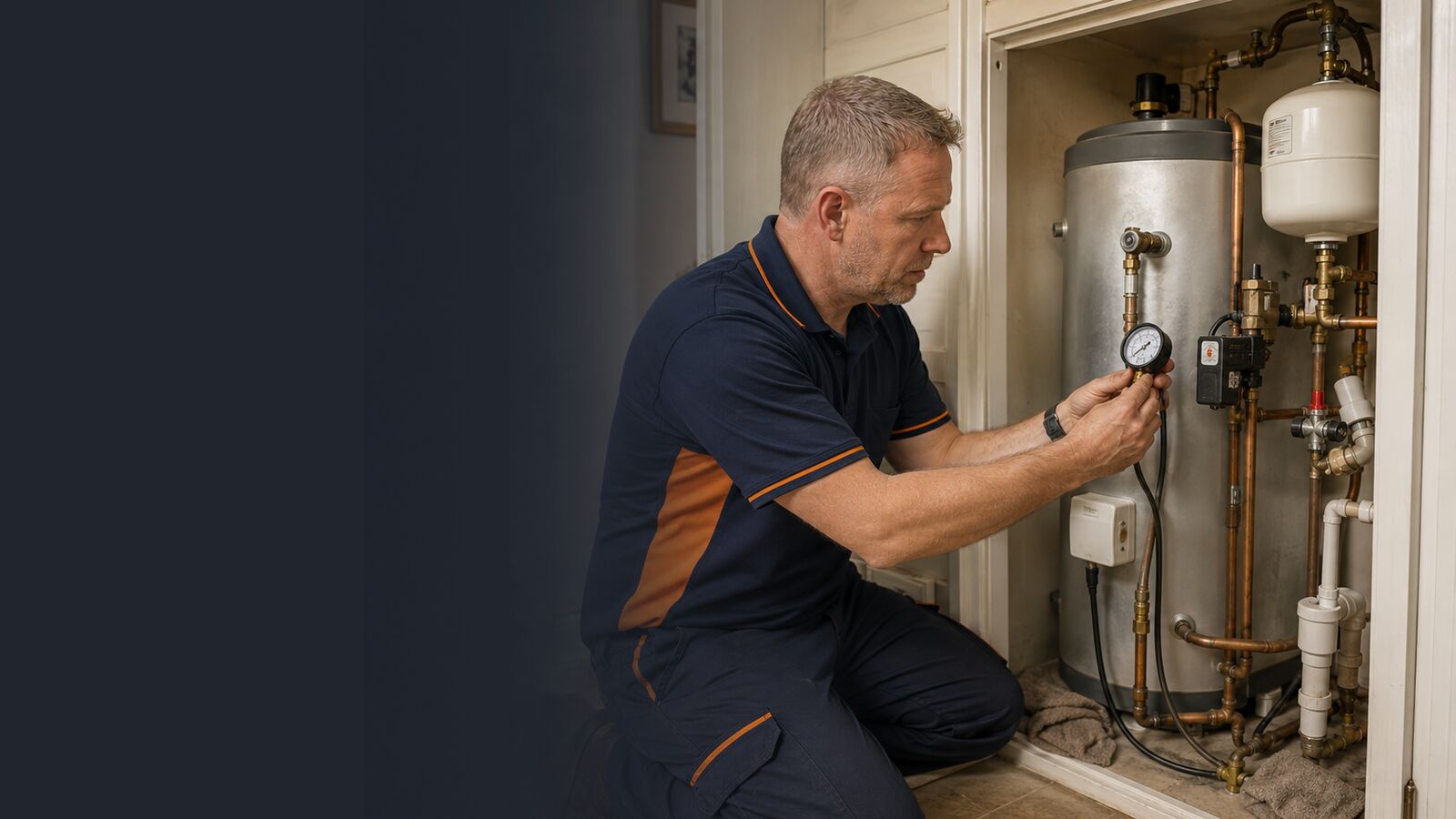
ASAP Boiler Repairs unvented cylinder repair

G3 qualified engineers

Unvented Cylinder Repair, London

Water at the tundish, no hot water, or a cylinder that keeps discharging. We hold both tickets, so the boiler and the cylinder are diagnosed in one visit rather than two.

Call 0203 868 6134

Answered 24 hours a day by a technical customer service member.

Water at the tundish is never normal, and it is almost never the valve that is dripping. The section below explains what it is actually telling you.

  • Gas Safe registered engineers
  • An engineer as soon as we can, booked around you
  • Cylinder and unvented systems as well as combis
  • Parts guaranteed for a year, rates agreed before work starts
No heating or hot water right now? Call 0203 868 6134. We will tell you the earliest realistic slot rather than the one you want to hear.
Google Reviews
  • "Very happy with this company very and professionally service. Fixed my leaking TRV and after draining my system and the refilled and vented the air . Thank you I have heating now"

    Jamie K.

  • "These guys provide an excellent service. A pleasure to deal with and professional"

    Day Walker

  • "Efficient and amiable service all round. Even managed to save me money by fixing a thermostat that we thought was broken."

    Graziano B.

Prefer we call you? Request a call back

Two details to start. Tell us the make on the cylinder and what you are seeing, and we can usually name the part before we attend.
No obligation. If it turns out to be the boiler rather than the cylinder, we will tell you that on the phone.

We use your details only to respond to your enquiry. See our privacy policy.

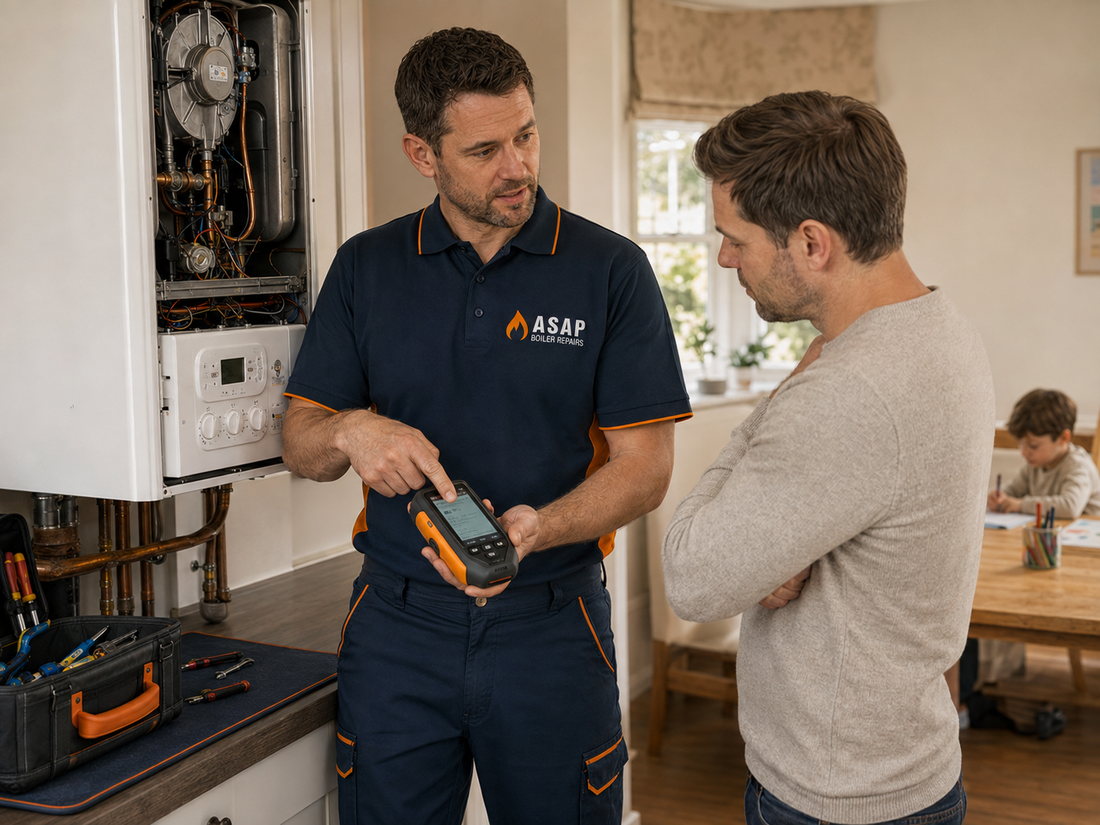
ASAP Boiler Repairs engineer explaining a boiler diagnosis to a homeowner

What happens when you call

Three steps, and you will know where you stand before an engineer is booked.
  1. Tell us the make and what you can seeThe make is on a label on the cylinder. Then whether water is at the tundish, whether the hot water has gone completely or just runs out early, and whether there are tanks in the loft. Those answers usually separate the cylinder from the boiler before anybody sets off.
  2. The likely part, and a realistic slotWe tell you the likely part and a realistic slot. If we cannot reach you today we say so on the phone, rather than after you have waited in.
  3. The engineer attends and runs a full diagnosticYou get a written breakdown before any repair begins: what has failed, what the parts and labour come to, whether the part is on the van or has to be ordered, and roughly how long the work will take. Nothing goes ahead until you have seen that and agreed to it. Parts are guaranteed for a year.

The London boiler firm that tells you whether it is the boiler or the cylinder before anyone attends. Most heating firms are Gas Safe registered and stop at the appliance. Most plumbers who hold G3 do not touch the boiler. When the hot water goes, that gap is why people pay for two visits to find one fault.
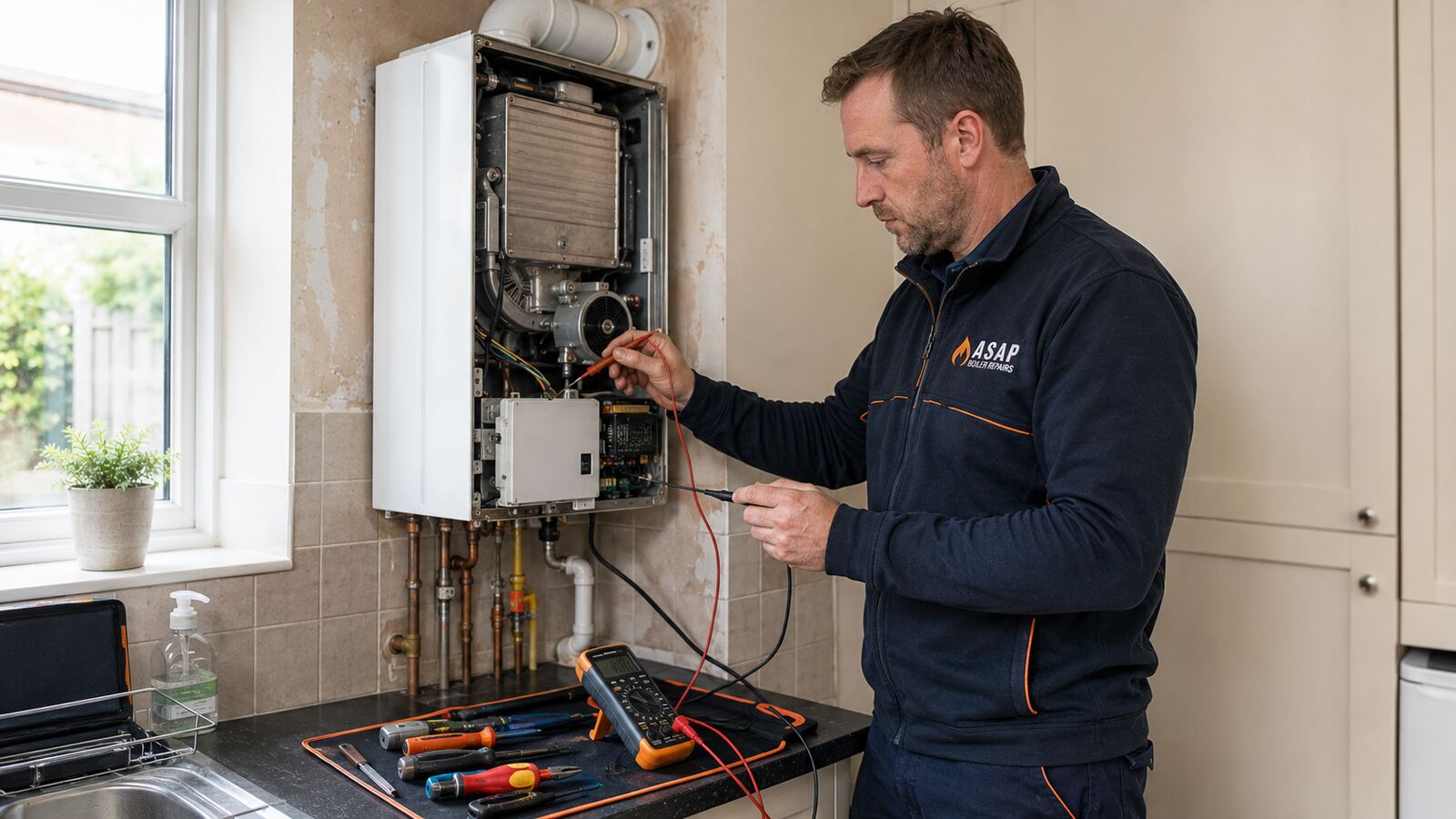
ASAP Boiler Repairs engineer completing a boiler diagnostic check

Vented, unvented or a thermal store

Three ways of storing hot water, and only one of them is a pressure vessel. Two minutes in the airing cupboard tells you which you have.

Unvented, fed straight off the mains

The cylinder is connected directly to the incoming main and the water inside is stored under mains pressure. No tanks anywhere. You get the same pressure at a first floor shower as at the kitchen tap, which is the whole reason people fit them. How to recognise it: a white or stainless cylinder with a cluster of valves on the cold inlet, a small pipe running to an open funnel called a tundish, and no cold water tank in the loft. The trade-off: stored water under pressure is a pressure vessel, so it carries a set of safety devices and it is governed by Approved Document G3 of the Building Regulations wherever it holds more than 15 litres.

Vented, fed from a tank in the loft

The older arrangement, and still common in Victorian and Edwardian houses across London. A large cold water cistern in the loft feeds the cylinder, and the pressure at your taps comes from how far the water falls. That is why the top floor shower is feeble and the ground floor one is fine. How to recognise it: tanks in the loft, usually one large and one small, and a copper cylinder with a vent pipe rising from the top. No tundish and no valve cluster. What it means for repairs: simpler and cheaper. There is no G3 requirement because nothing is stored under pressure, and the faults are the immersion, the thermostat, the coil or a motorised valve rather than a safety device group.

A thermal store, which works the other way round

Less common and often misdiagnosed. The cylinder stores heated heating water, and your mains cold water passes through a coil inside it and comes out hot on demand. You get mains pressure hot water without ever storing mains water under pressure. Why it matters: it is not an unvented cylinder, so it needs no G3 qualification and has no T and P valve. Engineers who assume every mains pressure cylinder is unvented go looking for safety devices that were never fitted.

Water at the tundish, and what it is actually telling you

This is the single most common call we take on cylinders, and the dripping valve is almost never the fault.
The tundish is the small open funnel in the discharge pipe. It is deliberately visible and it is deliberately open, so that anybody walking past can see the system has discharged. Water there is never normal and it is never something to live with.
What we find, in order of frequency Why it discharges
The expansion device has failed An external vessel has waterlogged, or on a Megaflo the internal air bubble has been absorbed into the water. With nowhere for the expansion to go, pressure rises on every heat cycle and lifts a valve
The pressure reducing valve is passing Or the incoming mains pressure has risen. The working pressure creeps up past what the relief valve will hold
The relief valve will not reseat Debris or scale on the seat. It opened for a good reason once and never closed again
The water is genuinely too hot The thermostat has failed and the cut-out has not. This is the serious one and the valve is doing exactly its job
Be careful near it. Water leaving a temperature and pressure relief valve can be at ninety degrees. It is not a dripping tap. What not to do: cap it, plug it, or put a bucket underneath and stop thinking about it. That pipe is the only route the cylinder has to relieve itself, and the reason it must terminate somewhere visible is so nobody does exactly that.
Did you know A Megaflo has no external expansion vessel. It uses an air bubble trapped inside the cylinder instead, and over the years that air is gradually absorbed into the water. When it goes, the tundish drips. Replenishing it is a procedure rather than a part, it belongs in the annual service, and the instructions are printed on the side of the cylinder. Plenty of Megaflo owners have been sold a new valve for a fault that a twenty minute recharge would have cleared.

Tundish dripping, or hot water gone?

Tell us the make on the label and what you can see. On a cylinder those two answers usually name the part before anybody sets off, which is the difference between one visit and three.
Call 0203 868 6134

The safety devices, and what each one is for

Four layers, each catching the failure of the one before it. Knowing which is which turns a mystery into a diagnosis.
Device Its job Typical setting
Pressure reducing valve Sets the working pressure of the whole system Commonly 3 bar
Expansion vessel or air bubble Absorbs the extra volume as water is heated Pre-charge matched to the pressure reducing valve
Thermostat Controls the stored water temperature 60 to 65 degrees, and not below 60
High limit cut-out Cuts the heat if the thermostat fails. Does not reset itself Around 80 to 85 degrees
Expansion relief valve Lifts on pressure alone. The everyday nuisance valve Around 6 to 8 bar, depending on the make
Temperature and pressure relief valve The last line of defence, opening on either Around 90 to 95 degrees or 7 bar, whichever the water reaches first

Why a waterlogged vessel tests fine, and how it is actually checked

This is the mistake that sends people home with the fault still there. An expansion vessel checked while the system is still under pressure reads whatever the water is pushing back at the gauge, so a completely waterlogged vessel looks healthy. The correct method: isolate the cold supply, open a hot tap and let it run until it stops, which expels the water side. Leave the tap open. Only then does a gauge on the Schrader valve read the actual air charge. Anybody who has done that will tell you the reading. If a vessel was pronounced fine without the water being drained off first, it was not tested.

The one part that is never improvised

The temperature and pressure relief valve is factory fitted and it is the device standing between a sealed vessel of very hot water and the room. It is never removed, never capped, and never replaced with anything other than an identical specification. It is tested by lifting the lever and confirming water flows freely and that it closes again afterwards. If it does not reseat it is replaced, not persuaded shut. A valve held closed with force is a valve that will not open when it needs to.
The discharge pipework has rules too. It runs continuously downhill, in a frost free route, at least one pipe size larger than the valve outlet, and it terminates somewhere visible and safe, usually over a gully outside. In a flat where that is impossible there are permitted alternatives, but a pipe disappearing into a void with no visible end is not one of them and it is a common insurance survey finding.
Woman homeowner speaking with a heating engineer after the repair is complete

The other faults, and what each one points at

Hot water problems narrow down quickly once you describe them precisely.
  • No hot water at all, heating fine. The immersion, the cylinder thermostat, a motorised valve that has stopped opening, or the coil. Not the boiler, which is proving itself by heating the radiators.
  • Hot water runs out far too quickly. Usually the heating period is too short, the thermostat is set low, or the coil has scaled and cannot transfer heat fast enough to recover the cylinder.
  • Poor flow at the taps, hot and cold. Often the strainer inside the pressure reducing valve housing, which silts up and is cleanable, rather than anything expensive.
  • Scalding water. A failed thermostat with the cut-out still holding. Approved Document G sets a maximum of 48 degrees at a bath, which is what a thermostatic mixing valve is for, and it matters most where there are children or elderly residents.
  • Rumbling or kettling from the cylinder. Scale on the immersion element. London water runs at roughly 277 milligrams of calcium carbonate per litre, and elements in stored water scale directly.
The one to ring about rather than watch. Any of these alongside water at the tundish, or hot water that has become unpredictably hot, is a safety device reporting a fault rather than an inconvenience. If the heating has gone as well, that is emergency boiler repair, and if the radiators are cold at the bottom too the primary side needs a power flush rather than a cylinder part.

Who is allowed to work on it, and why the annual service is not optional

Two separate qualifications, and most firms hold one of them.
You are probably wondering whether your usual heating engineer can do this. Possibly not, and it is worth checking rather than assuming. Approved Document G3 covers unvented hot water storage over 15 litres, and only a person holding the specific qualification may install or commission one. That ticket is separate from Gas Safe registration and is renewed on a five year cycle. Gas Safe registration does not cover unvented work at all. A firm with Gas Safe alone can legally service your boiler and not legally commission your cylinder, which is why so many households end up with two trades and a gap between them. Our engineers hold both. What an annual service actually consists of, and it is not a look at the cylinder: every safety device operated and confirmed to reseat, the expansion charge measured with the water side drained, the high limit cut-out checked, the thermostat verified, the discharge pipework inspected for blockage or signs of past discharge, and the immersion checked for scale. That is also the visit at which a Megaflo air bubble is replenished.
The warranty point. Modern duplex stainless cylinders commonly carry very long tank guarantees, and they are conditional on annual servicing being carried out and recorded. A cylinder that has never been serviced is a cylinder with no cover on the most expensive part of it. It sits naturally alongside an annual boiler service in one visit.

When a cylinder stops being worth repairing

Age alone is not the test, and a well maintained cylinder lasts a very long time. The threshold is arithmetic. Once the expansion vessel, the pressure reducing valve and the relief valves have each been replaced two or three times on a unit from the nineteen nineties or early two thousands, the money has gone into an old vessel rather than a new one with a fresh guarantee. A leaking cylinder body is the decisive one. Everything else on an unvented system is a serviceable part. The vessel itself is not. Our guide to repair and replacement costs sets out what drives the figure, and where the boiler is of a similar age the two are usually worth planning together on the boiler installation page.
Where both tickets are needed at once. A Powermax is a boiler and a pressurised store in the same case, which is exactly the appliance that needs Gas Safe and G3 together in one visit. Our Powermax 155x case study is that job, photographed.

Local boiler repair specialists

Clear advice. Careful repairs. Family-friendly service. Call 0203 868 6134

Where we cover

London, north and south of the river. These are the districts we work in most.

These are where we work most, not a boundary. An engineer attends anywhere in north London and south London. Tell us where you are and we will say plainly when we can get to you.

Districts including Richmond and Twickenham, Notting Hill and Holland Park and Sydenham and Forest Hill each have their own page with the housing stock and the postcodes set out. We work across boiler repair in north London and boiler repair in south London, and the full list is on areas we cover.
Safety
If you smell gas: do not touch any switches. Open the windows, leave the property, then call the National Gas Emergency Service on 0800 111 999. That line is free and open 24 hours. Call them before you call us. If a carbon monoxide alarm is sounding: get everyone out immediately, then call 999 if anyone feels unwell. Do not go back in until the property has been ventilated and checked. If the boiler locks out repeatedly: try one reset. If it locks out again straight away, stop. Repeated resets hide a fault that is still there, and on a gas appliance that is not a risk worth taking. Under the Gas Safety (Installation and Use) Regulations 1998, only a Gas Safe registered engineer may work on gas appliances. Never open the boiler casing yourself.

Unvented cylinder FAQs

Why is water coming out of my tundish?

Because a safety device has operated, and the usual reason is that the expansion of heated water has nowhere to go. Most often the external expansion vessel has waterlogged, or on a Megaflo the internal air bubble has been absorbed into the water. After that comes a pressure reducing valve that is passing, then a relief valve that has not reseated, and least often but most seriously, water that is genuinely too hot. It is never normal and it is never something to cap off. Be careful near it: discharged water can be at ninety degrees.

Do I have a vented or an unvented cylinder?

Look in the loft and at the cylinder. Tanks in the loft and a vent pipe rising from the top of the cylinder means vented, fed by gravity, which is why upstairs showers are weak. No tanks, plus a cluster of valves on the cold inlet and a small open funnel called a tundish, means unvented and fed straight off the mains. There is a third type, a thermal store, which gives mains pressure hot water through a coil without storing mains water under pressure, so it has no tundish and needs no G3 qualification.

Does Gas Safe registration cover unvented cylinders?

No. They are two entirely separate qualifications. Gas Safe covers gas appliances. Unvented hot water storage over 15 litres falls under Approved Document G3 of the Building Regulations, and installing or commissioning one requires the specific G3 ticket, renewed on a five year cycle. A firm holding only Gas Safe can service your boiler but cannot legally commission your cylinder, which is exactly why households with a cylinder so often end up paying two trades to find one fault. Ours hold both.

What is the Megaflo air bubble?

Most unvented cylinders absorb the expansion of heated water in an external expansion vessel. A Megaflo does it with a bubble of air trapped inside the cylinder instead. Over the years that air gradually dissolves into the water, and when it has gone the pressure has nowhere to go and the tundish starts dripping. Replenishing it is a procedure rather than a replacement part, it belongs in the annual service, and the instructions are printed on the side of the cylinder. It is the single most commonly misdiagnosed fault on this make.

Do unvented cylinders need servicing every year?

Yes, and it is a genuine safety inspection rather than a formality. Every safety device is operated and confirmed to reseat, the expansion charge is measured with the water side drained, the high limit cut-out and thermostat are checked, and the discharge pipework is inspected for blockage or signs of past discharge. Long tank guarantees on modern stainless cylinders are conditional on it being done and recorded. It sits naturally in the same visit as an annual boiler service.

My hot water runs out too quickly. Is the cylinder failing?

Usually not. Three ordinary things cause it. The heating period is too short for the cylinder to recover between uses, the cylinder thermostat is set too low, or the coil has scaled and can no longer transfer heat quickly enough. London water runs at roughly 277 milligrams of calcium carbonate per litre, so scale is the common culprit on an older installation. All three are cheaper to address than a cylinder, and none of them means the vessel has failed.

Is my old cylinder worth repairing?

Almost always yes, because everything except the vessel itself is a serviceable part. Expansion vessels, relief valves, thermostats, immersions and pressure reducing valves are all replaceable. The one decisive failure is the cylinder body leaking, which cannot be repaired. The arithmetic changes on a unit from the nineteen nineties or early two thousands where the vessel, the reducing valve and the relief valves have each been replaced two or three times already. At that point the money is better spent on a new cylinder with a fresh guarantee, and if the boiler is a similar age the two are worth planning together as a boiler installation.

Which areas do you cover?

London, north and south of the river, across twenty six districts. Richmond and Twickenham, Notting Hill and Holland Park, and Sydenham and Forest Hill are three of them. We do not qualify coverage by distance or add conditions to particular postcodes, and we work for landlords and managing agents alongside our landlord gas safety certificate visits. The full list is on our areas we cover page.

The boilers we pair cylinders with

A cylinder is heated by something, and when the hot water goes the fault sits on one side or the other. These pages cover the appliance half.
Every make is listed on the boiler makes we repair. For a fault on the appliance rather than the cylinder, see gas boiler repair, or electric boiler repair where there is no gas supply. If you would rather write than ring, contact a boiler engineer in London.
Google Reviews
  • "Very professional and would recommend to anyone!"

    Abby M.

  • "He was very professional tidy and polite. Would recommend!"

    Anna M.

  • "Took his time to listen to my concerns hence it was a nice job. Thank u so much"

    Frank E.

Book a cylinder engineer

Have the make from the label and what you can see ready if you can. With those two pieces of information we can usually tell you what has failed and whether it is the cylinder or the boiler before anybody is booked in.

Gas Safe registered. Unvented cylinder qualified. Parts guaranteed for a year. Covering London, north and south of the river, 24 hours a day.


Call Book Now