Gas Safe registered

Vaillant specialists

ecoTEC plus, ecoTEC pro, ecoFIT and the older turboMAX. Twenty years on Vaillant boilers, rates agreed beforehand, parts guaranteed a year.
Answered 24 hours a day by a technical customer service member.
Vaillant write their codes with a full stop, so it is F.75 rather than F75.
No heating or hot water right now? Call 0203 868 6134. We will tell you the earliest realistic slot rather than the one you want to hear.
Give us the Vaillant code and your postcode and we can usually name the part.
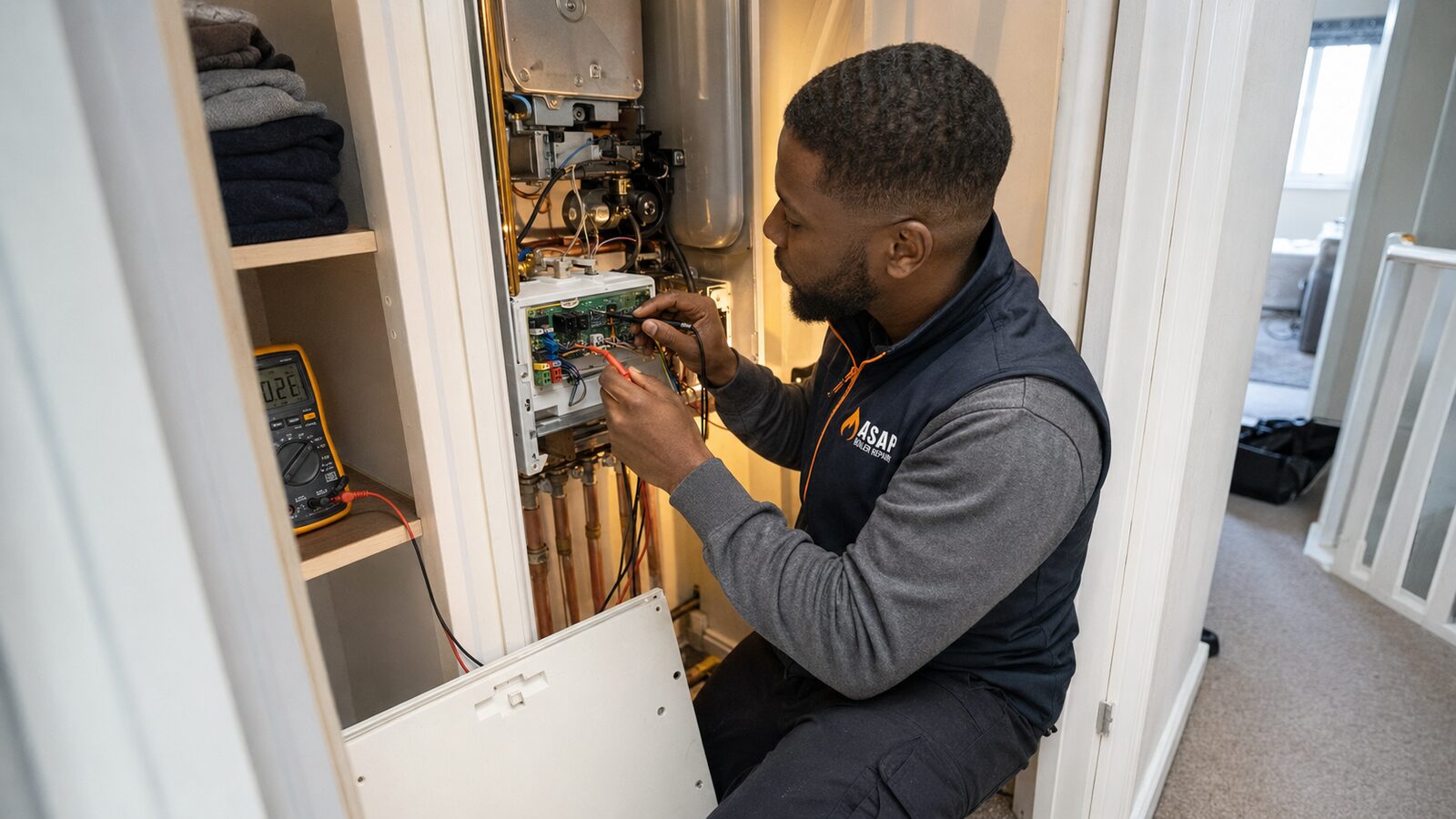
Three steps, and you know where you stand before booking.
On a Vaillant, F.75 is the water pressure sensor or an expansion vessel that has lost its charge. It is rarely the pump, which is why replacing the pump so often fails to clear it. You are probably wondering whether this call ends with somebody telling you to buy a new boiler. On a twelve year old ecoTEC with one failed sensor, it does not. We are the London firm that tells you whether it is the boiler or the cylinder before anyone attends.
Vaillant write every fault as an F and a full stop, so F.75 rather than F75. Glow-worm and Heatline share the numbering, all three in the Vaillant Group.
F.75 means the boiler started the pump and did not detect the pressure change it expected. It is the water pressure sensor or an expansion vessel that has lost its air charge. It is rarely the pump, which is why replacing the pump so often fails to clear it.
What separates the two: a flat vessel shows pressure swinging widely between cold and hot, a failed sensor a steady gauge with the code still showing. Both are testable in minutes.
F.28 means the boiler never lit. F.29 means it lit and lost the flame while running, and the difference decides the repair. Try a hob first, because no gas anywhere is not a boiler fault, and in winter thaw the condensate pipe.
Failing to light points at the spark side and the gas supply. Losing a flame points at the sensing electrode or the flue. Fitting an ignition electrode on an F.29 changes a part that was working.
F.22 is genuine low water pressure, and the one Vaillant code most householders can clear. Fill through the loop cold to between 1 and 1.5 bar, close both valves firmly, reset once. Every few weeks means a leak, every few days means the expansion vessel has lost its charge, which is what turns an F.22 into an F.75. Topping up repeatedly draws oxygenated water in, which is how sludge forms.
The boiler lit and then lost the flame. In a London winter the usual cause is the condensate pipe freezing outside, so it cannot discharge and shuts down. Thaw the white plastic pipe with warm water, never boiling.
If it recurs every cold snap the pipe is too narrow, too long or falls the wrong way, and lagging will not fix a routing problem. Otherwise it points at the ionisation electrode or gas pressure sagging under load.
The boiler saw the gas valve fail to close when it should have. This is not one to sit on and not one to reset past, because it concerns the device that stops gas reaching the burner.
It is usually the valve itself or its wiring, and it needs a gas rate and soundness check rather than a parts swap. F.61 sits alongside it and means the control side of the same valve.
Water passed the limit the overheat thermostat allows and the boiler stopped. The thermostat is reporting the problem rather than causing it, so replacing only that means it trips again within days.
Look at circulation first: a jammed pump, a closed valve, trapped air or sludge all leave the boiler making heat faster than the system carries it away. Let it cool fully before a single reset.
The fan is not turning at the speed the board expects. On an ecoTEC that is the fan, its wiring, or a flue that is restricted or has come apart.
Worth checking the flue before ordering a fan. A blocked terminal or a joint that has pulled at a bend produces the same code, and a fan fitted to a restricted flue fails again.
| Vaillant code | What it means | What it usually turns out to be |
|---|---|---|
| F.20 | Overheat safety cut-out | Circulation, not the burner. Pump, air or sludge |
| F.27 | Flame detected when there should be none | Safety critical. Engineer rather than reset |
| F.32 | Fan fault | The fan, its plug, or a restricted flue |
| F.61 / F.62 | Gas valve control or shut-off | The valve or its wiring. Not a reset job |
| F.73 to F.84 | Sensor signal out of range, or sensors disagreeing | The sensor itself, or circulation |
Vaillant, Glow-worm and Heatline all sit in the Vaillant Group and share the F numbering, so an F.75 means the same on all three. That is why a Vaillant code search often returns Glow-worm results, and why it is worth saying the make as well as the number when you ring. Searching F75 without the dot misses much of what is written about it.
Two account for most Vaillant calls.
Hot water never properly hot, heating faultless. The plate heat exchanger is scaling. The heating circuit is sealed so it scales once; the hot water side takes fresh mains at every tap. A diverter fault gives none, and an annual service catches it early.
Pressure falling with no visible leak. Usually the expansion vessel rather than pipework, the same failure that produces F.75. A recharge costs a fraction of chasing a leak that is not there.
F.75 is rarely the pump
It is the water pressure sensor or an expansion vessel that has lost its charge, both testable in minutes. Replacing the pump is the most expensive wrong turn on this brand.
The range decides the parts, and the label carries it.
ecoTEC plus and ecoTEC pro are the ranges most often on London walls, with ecoFIT pure below them and the older turboMAX and ecoMAX in properties untouched this century. A number like 832 is a 32 kilowatt combi; 415 or 618 is a system boiler, so there is a cylinder somewhere. When you ring, read us the model and serial if they are to hand. We work on every make of boiler.
The biggest difference between repairing one here and where it was designed.
Water here carries roughly 277 milligrams of calcium carbonate per litre, from chalk the Thames and the Lea run through, so the plate heat exchanger scales faster than the manual allows, in Highgate as Kingston.
Scale drops out of solution faster the hotter the water gets. A combi delivering taps at 65 degrees furs up faster than one at 50, which is still hot enough to scald, and turning the dial down costs nothing. It applies to the tap setting, not a cylinder, which must reach 60 degrees.
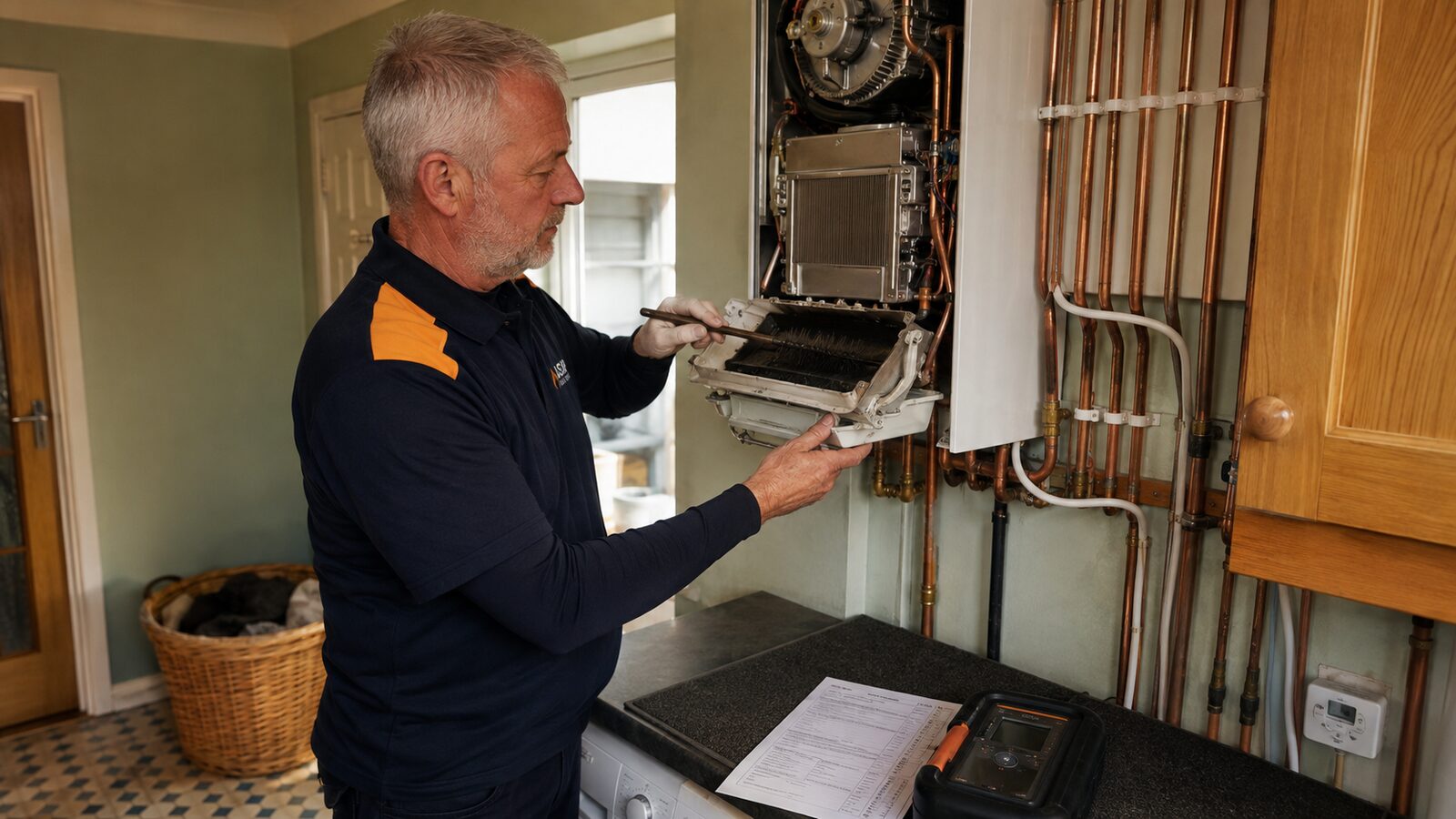
Age does not decide it. The failed part does.
| What has failed | Under 8 years | 8 to 14 years | 15 years and older |
|---|---|---|---|
| Pressure sensor, thermistors | Repair | Repair | Repair if parts exist |
| Expansion vessel | Repair | Repair | Repair |
| Ignition and sensing electrodes | Repair | Repair | Repair |
| Pump, fan | Repair | Repair | Depends on the rest of the boiler |
| Diverter valve, plate heat exchanger | Repair | Repair | Repair if the part is still made |
| Gas valve | Repair | Borderline, we will be straight with you | Replace |
| Control board | Check the guarantee first | Borderline, we will be straight with you | Replace |
| Main heat exchanger | Guarantee claim if registered | Worth a second opinion | Replace |
Under eight years old a Vaillant repair is not in question, and guarantee cover is worth knowing because cover runs longer than most. Between eight and fourteen only a board or main heat exchanger changes the conversation. Past fifteen availability decides, particularly on turboMAX and ecoMAX. See boiler replacement and our cost guide.

Most firms here are combi-only, which suits few large houses.
A Vaillant 415 or 618 runs a stored cylinder with its own thermostat, immersion element and, if unvented, its own safety devices. When the hot water goes the boiler takes the blame and is often fine, the fault being a cylinder sensor, a failed motorised valve, or a scaled immersion element. None shows an F code.
Water at its tundish means a safety device has failed, and is never something to cap. That needs G3 as well as Gas Safe registration and we hold both, so unvented cylinder repair happens on the same visit, and houses in Purley and Kenley usually get a scale reducer with it.

Local boiler repair specialists
Clear advice. Careful repairs. Family-friendly service.
Call 0203 868 6134North and south of the river.
These are where we work most, not a boundary. An engineer attends anywhere in north London and south London. Tell us where you are and we will say plainly when we can get to you.
If you smell gas: do not touch any switches. Open the windows, leave the property, then call the National Gas Emergency Service on 0800 111 999. That line is free and open 24 hours. Call them before you call us.
If a carbon monoxide alarm is sounding: get everyone out immediately, then call 999 if anyone feels unwell. Do not go back in until the property has been ventilated and checked.
If the boiler locks out repeatedly: try one reset. If it locks out again straight away, stop. Repeated resets hide a fault that is still there, and on a gas appliance that is not a risk worth taking.
Under the Gas Safety (Installation and Use) Regulations 1998, only a Gas Safe registered engineer may work on gas appliances. Never open the boiler casing yourself.
F.75 on a Vaillant is the water pressure sensor or an expansion vessel that has lost its charge. It is rarely the pump, which is why replacing the pump so often fails to clear it. A flat vessel shows pressure swinging between cold and hot; a failed sensor shows a steady gauge with the code still displayed. Both are testable in minutes. No heat meanwhile? See emergency boiler repair.
F.28 means the Vaillant never lit at start-up, F.29 means it lit and lost the flame while running. Failing to light points at the spark side and the gas supply, losing a flame at the sensing electrode or the flue, so fitting an ignition electrode on an F.29 changes a part that was working. Worn electrodes are what an annual service catches early.
Between 1 and 1.5 bar with the system cold. F.22 means it has dropped below that, and most householders can clear it: fill through the loop cold, close both valves, reset once. Every few weeks means a leak, every few days means the expansion vessel has lost its charge, the same failure that produces F.75. Repeated topping up causes sludge.
Because Vaillant, Glow-worm and Heatline share the same F numbering, all three in the Vaillant Group, so an F.75 means the same on each. Vaillant write the code with a full stop, and searching F75 without it misses much of what is written about your boiler. Say the make as well as the number when you ring. The same overlap runs across the Glow-worm fault codes.
No honest figure exists until somebody knows which part has gone. Three things decide it: the component, whether we carry it or order it, and time on site. On a Vaillant the code usually names the part before anybody attends, which is why we ask for it first. Rates are agreed before work starts. Our guide to repair and replacement costs sets out what drives it.
Yes, and it is a large part of what we do. A Vaillant 415 or 618 runs a stored cylinder with its own thermostat, immersion element and, if unvented, its own safety devices. Unvented work needs G3 as well as Gas Safe registration and we hold both, so the cylinder is diagnosed on the same visit. A failed cylinder sensor shows no F code. See unvented cylinder repair.
Glow-worm shares Vaillant's numbering, which is why those codes look familiar.
No gas supply? Plenty of London flats run without one, so we also cover electric boiler repair.
When you ring, read us the Vaillant code with its full stop and the model. With those two we can usually name the part before anyone sets off.
Gas Safe registered. Unvented cylinder qualified. Parts guaranteed for a year. Covering London, north and south of the river, 24 hours a day.