4.6 Google reviews
Open 24 hours, 7 days Rates agreed before we start Gas Safe registered
Gas Safe registered
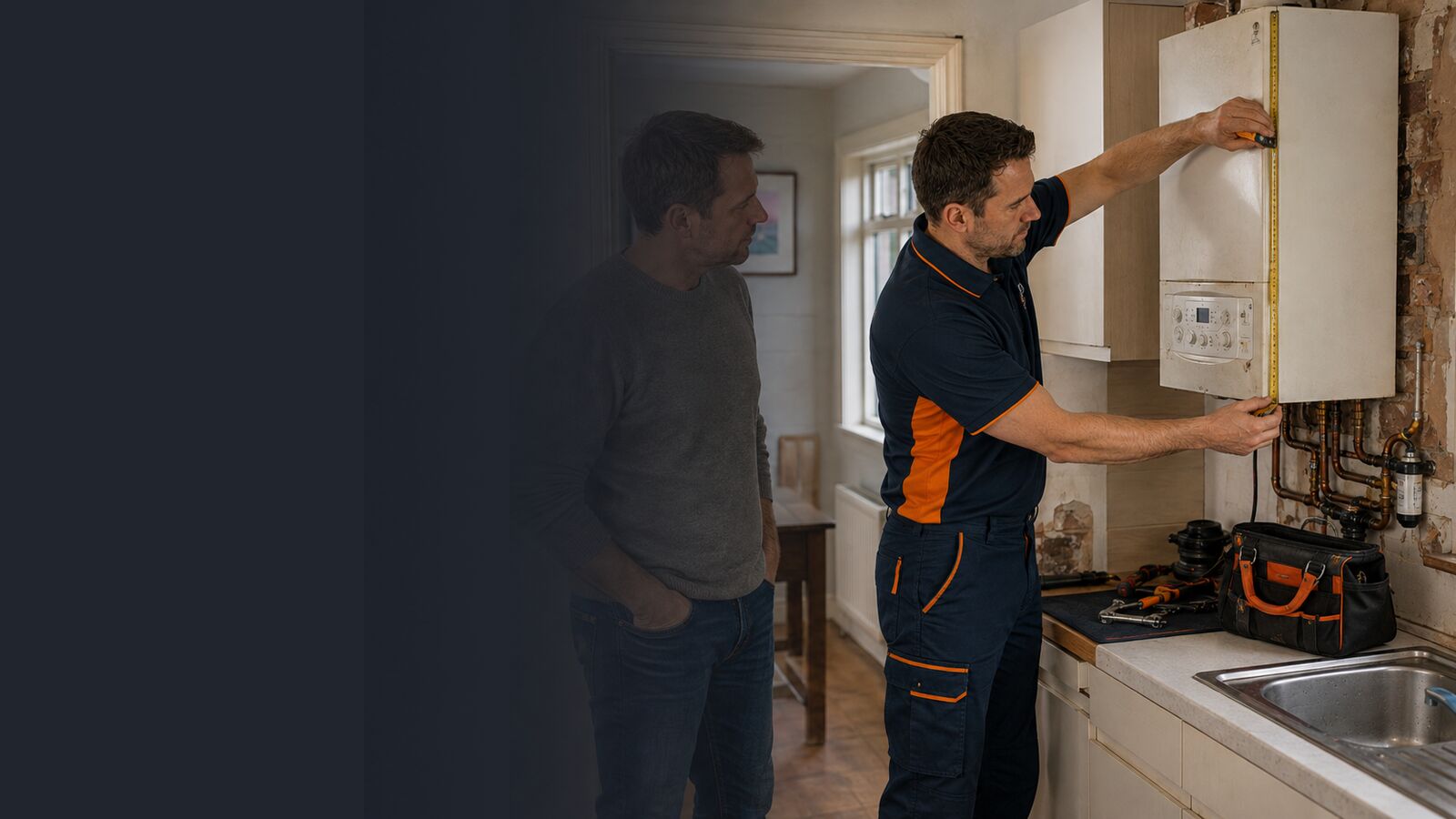
ASAP Boiler Repairs boiler replacement assessment

New boilers and replacements

Boiler Installation, London

Send us a few photographs. We give you a written quote the same day. The engineer arrives with everything on the van. Gas Safe registered, north and south of the river.

Call 0203 868 6134

Answered 24 hours a day by a technical customer service member.

The 2035 deadline for existing homes was dropped in January 2026. Plenty of quotes are still using it as a reason to hurry you.

  • Gas Safe registered engineers
  • An engineer as soon as we can, booked around you
  • Cylinder and unvented systems as well as combis
  • Parts guaranteed for a year, rates agreed before work starts
No heating or hot water right now? Call 0203 868 6134. We will tell you the earliest realistic slot rather than the one you want to hear.
Google Reviews
  • "Took his time to listen to my concerns hence it was a nice job. Thank u so much"

    Frank E.

  • "Engineer excellent and very time efficient."

    Fiona G.

  • "Very professional and would recommend to anyone!"

    Abby M.

Prefer we call you? Request a call back

Two details to start, then send photographs by WhatsApp or email. With the boiler, the flue and the meter we can usually quote without visiting.
No obligation. If the boiler you have is worth keeping for another few years, we will say so.

We use your details only to respond to your enquiry. See our privacy policy.

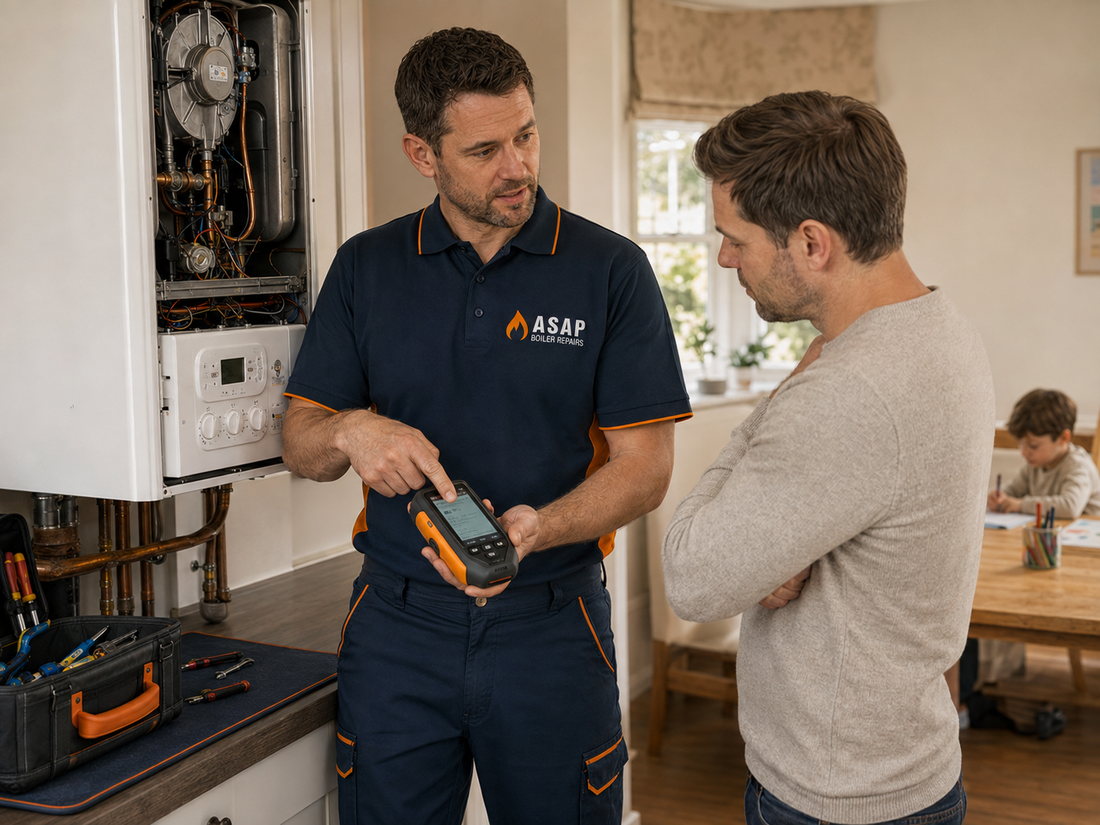
ASAP Boiler Repairs engineer explaining a boiler diagnosis to a homeowner

No hassle quotation

Three steps, and on a straight swap none of the first two needs anybody to visit.
  1. Send us photographsBy WhatsApp or email, on the number below. The boiler with its door open, the flue where it comes through the wall outside, the pipework around it and the gas meter. Add the bedrooms, the bathrooms and whether there is a cylinder or tanks in the loft. With the right information we can quote without visiting at all.
  2. A written quote the same day, then a dateItemised properly: the make, the output, what is included and what is not. If it suits you, we book the date. Where the photographs cannot answer the job, because the boiler is moving, the type is changing or the flue route is unclear, we will say we need to see it rather than quote a figure we would have to revise.
  3. The engineer arrives with everythingThe boiler, the flue kit, the filter, the inhibitor and the fixings come on the van. Nothing is ordered on the day and nobody leaves to fetch a part. The system is cleaned, the boiler is commissioned, the Benchmark record is completed and the guarantee is registered before we go.

If your boiler has years left in it, we will tell you that instead. An installation is the largest single job we quote for, and it is the one where a firm has the most to gain from telling you what you want to hear. We would rather lose a quote than fit a boiler you did not need.

Are gas boilers being banned?

Short answer, no, and the deadline most quotes still cite was dropped at the start of this year.
You are probably wondering whether fitting a gas boiler now is throwing money at something about to be outlawed. It is the question we get asked most, and the answer has changed recently enough that plenty of firms are still working from the old one.
What is true What it means for your house
No ban on gas boilers in existing homes You can buy, install and replace one. Nobody is coming to remove a working boiler
The proposed 2035 phase-out for existing homes was dropped Confirmed when the Warm Homes Plan was published on 20 January 2026. There is now no phase-out date
The Future Homes Standard comes into force on 24 March 2027 New build homes in England only, with a transition running to 24 March 2028
Gas will not meet that new build standard Nor will hybrids or hydrogen-ready boilers. It does not apply to your existing terrace, semi or flat
The Clean Heat Market Mechanism sets heat pump sales targets It applies to manufacturers, not to you. The trade press calls it the boiler tax

Hydrogen ready, and what the label actually promises

Most manufacturers now certify their boilers to run on a gas mixture containing up to twenty per cent hydrogen, and several make it standard rather than an option. That is a genuine thing and it costs you nothing extra. What it does not promise is that the boiler will run on pure hydrogen later. A full domestic conversion remains uncertain, and hydrogen-ready boilers do not satisfy the new build standard either. Treat it as a useful bit of future proofing rather than a reason to choose one make over another.

The heat pump question, answered straight

Grants exist. The Boiler Upgrade Scheme has been extended to 2030, was overhauled in April 2026, and the grant is applied for by an installer certified under the microgeneration scheme and deducted from your bill rather than paid to you. Amounts and eligibility have changed several times, so check the government's own page rather than a quote. Where we stand: we are a Gas Safe firm. We fit and repair gas and electric boilers and we do not install heat pumps, so if that is the route you want, you need a certified installer rather than us. We would rather say that plainly than talk you out of it to keep the job. What we will do is tell you honestly whether your property suits one. Radiator sizes, insulation and where a unit would physically go decide it, and a Victorian conversion with small radiators is a different proposition from a well insulated semi.
Did you know The 2035 date has appeared in boiler adverts for years as a reason to act now. The government confirmed there would be no phase-out date for gas boilers in existing homes when it published the Warm Homes Plan in January 2026, replacing the deadline with grants. If a quote is still using 2035 to hurry you, that tells you how current the rest of its information is.
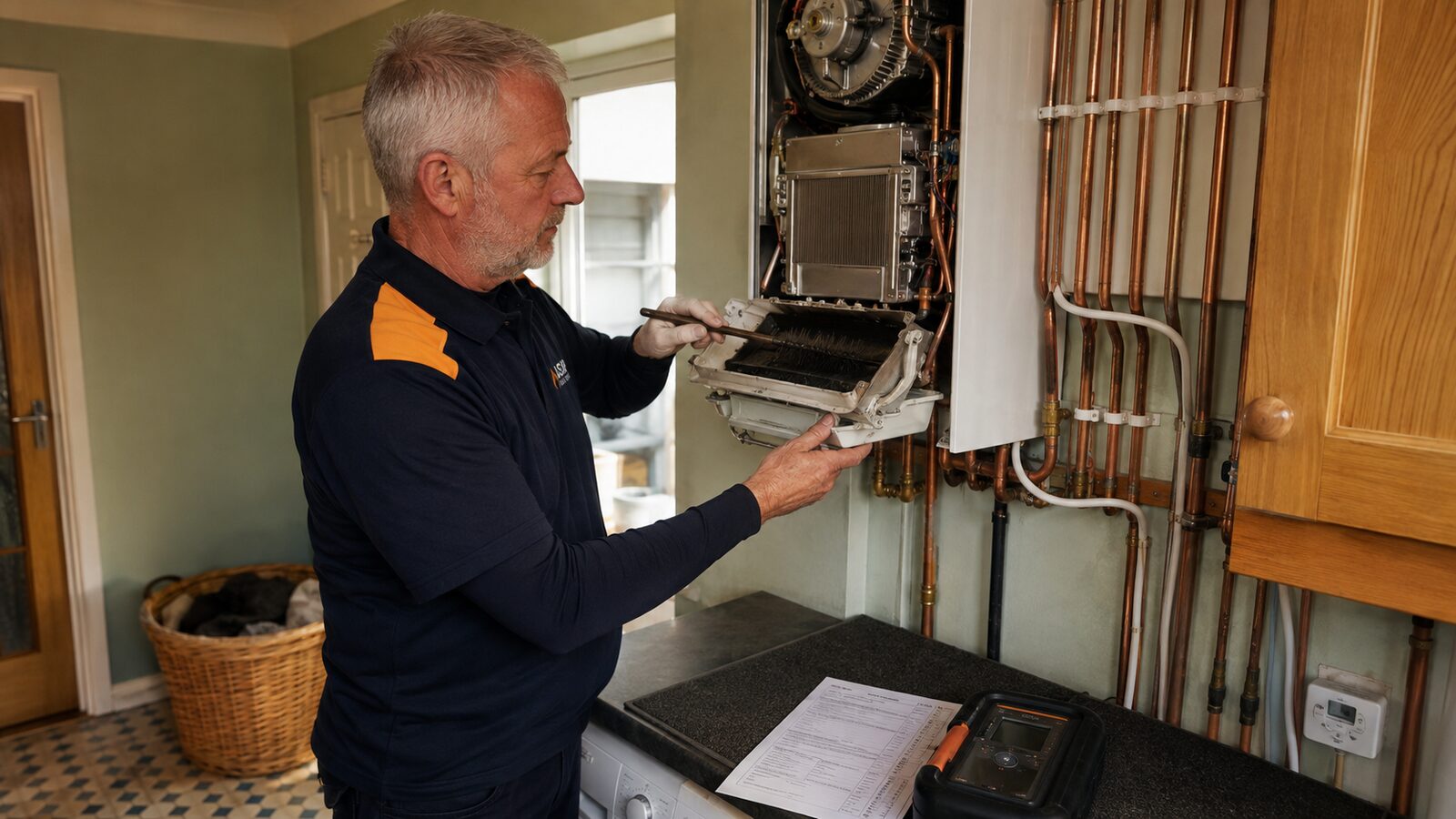
ASAP Boiler Repairs engineer servicing a boiler heat exchanger

Combi, system or regular, and which your property can take

Three types, and the choice is decided by bathrooms and mains flow rate rather than by the size of the house.

Combi, heating water as it passes

No cylinder, no tanks, hot water on demand from the mains. It frees up a cupboard and an airing space, which in a London flat is often the whole argument. The limit nobody mentions until afterwards: a combi can only deliver what the incoming main can supply. Two showers at once, or a bath filling while somebody washes up, and the flow divides. That is not a fault and no boiler fixes it. The test that decides it: measuring the mains flow rate at the property before anything is quoted. It takes a few minutes with a jug and a stopwatch and it is the single most skipped step in the trade. A combi fitted to a poor main is a complaint waiting to happen.

System boiler with a cylinder

A sealed system feeding a hot water cylinder, usually unvented, with no tanks in the loft. Hot water is stored, so several outlets can run at once without the flow collapsing. Right for: two or more bathrooms, or any household where showers overlap. Also the sensible answer where the mains flow rate rules a combi out. What it costs you: the cupboard. And the cylinder is a second appliance with its own safety devices and its own service needs, covered on our unvented cylinder repair page.

Regular, also called heat only or conventional

A cylinder plus a cold water tank and a small feed tank in the loft, gravity fed. Common in Victorian and Edwardian houses across London that have never been converted. Worth keeping when: the pipework is old and the property has good gravity pressure, or the loft tanks feed other things. Converting to a sealed system means every radiator and joint suddenly sees pressure it has never seen, and on very old pipework that finds leaks. Worth changing when: you want the loft back, or the tanks are the reason the hot water is feeble upstairs.
The conversion that goes wrong most often. Cylinder to combi in a house with two bathrooms and a mediocre main. It looks like a straight swap on a quote and it is the change people most regret. If you are considering it, ask for the measured flow rate in writing before you agree to anything.

Why your last boiler was probably too big

Oversizing is the most common fault in British boiler installation, and it is invisible until the bills arrive.
The correct method is a heat loss calculation: room by room, allowing for wall construction, glazing, exposure and ventilation, producing a figure in kilowatts. The common method is to read the badge on the old boiler and fit something similar, or to round up because bigger feels safer. Why bigger is worse. An oversized boiler reaches temperature quickly, shuts off, cools and fires again. That cycling wears components, and worse, it stops the boiler condensing properly, which is the entire reason a condensing boiler is efficient. A boiler running at high flow temperatures in short bursts is an expensive appliance being used badly.
The exception worth understanding. On a combi, the output figure is set by hot water demand rather than by heat loss, because heating water instantly takes far more power than warming radiators. That is why a small flat can correctly have a 30kW combi. On a system or regular boiler there is no such excuse, and the heat loss figure is the answer.
Ask for the heat loss figure. A firm that has done one will give you a number without hesitating. A firm that has not will talk about bedrooms and radiators instead, and that is the tell. Where a quote from photographs is enough, and where it is not. A like for like swap into the same property with the same radiators has the same heat loss as before, so the figure is already settled and photographs answer the rest. A change of boiler type, a loft conversion, an extension or a new bathroom changes the heat loss, and that is a survey rather than a photograph.
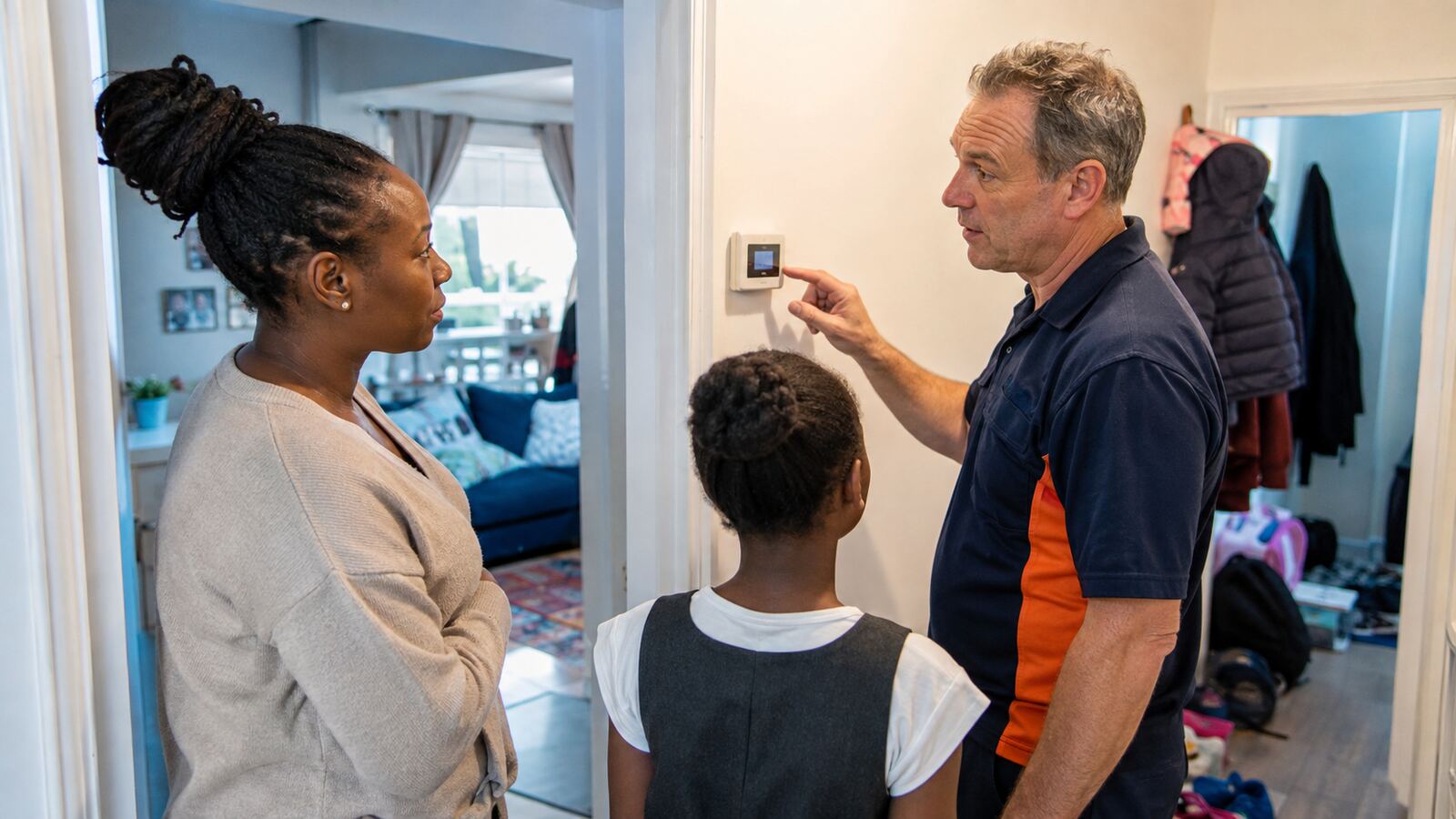
Heating engineer explaining thermostat controls to a mother and daughter

What a compliant installation has to include

Boiler Plus has applied in England since April 2018 and a surprising number of installations still miss part of it.
Requirement What it means in practice
Minimum efficiency A new gas boiler must reach at least 92 per cent on the energy label
Time and temperature control Every installation, no exceptions. A programmer and a room thermostat at minimum
One extra measure on a combi Flue gas heat recovery, weather compensation, load compensation, or smart controls with automation and optimisation
Notification to building control A Gas Safe registered installer self-certifies. You should receive the certificate
Benchmark commissioning record Completed on the day, in the booklet from the box. This is what a warranty claim is judged on
Guarantee registration Usually within thirty days of installation, or the longer cover does not start
The extra measure on a combi is the one most often quietly skipped, because all four options cost money and none of them is visible once the job is finished. Ask which one is being fitted and get it named on the quote. Weather and load compensation are the two worth understanding, because they do the same thing from different directions. Weather compensation reads an outside sensor and lowers the flow temperature when it is mild. Load compensation reads how far the room is from its target and does the same. Both keep the boiler condensing for longer, which is where the efficiency on the label actually comes from.

What has to happen before the new boiler goes on

Three things, and skipping any of them is how a new boiler fails inside its guarantee.
Clean the system first, never afterwards. Fit a boiler to a dirty system and magnetite circulates through the new heat exchanger from the first firing, in an appliance with far narrower waterways than whatever it replaced. Take a water sample before any work is agreed. Dark water means cleaning belongs in the quote rather than appearing later as an extra, and our power flush page sets out which method suits which system. Fit the filter and dose the inhibitor. A permanent in-line filter on the return is required on every system under BS 7593:2019, and inhibitor goes in after cleaning, at strength, in a type compatible with aluminium heat exchangers. Manufacturers commonly make both conditions of the extended guarantee, and the state of the system water is among the first things investigated when a heat exchanger claim arrives. Protect against scale. London water runs at roughly 277 milligrams of calcium carbonate per litre, and the standard asks for scale protection where hardness is above 200. That covers effectively every property in the city. A scale reducer on the incoming main is a small item on a large quote and it protects the most expensive part of the boiler.
What should be itemised on any quote you accept: the make and model, the output in kilowatts, the heat loss figure it came from, which Boiler Plus measure is included, the system clean and its method, the filter, the inhibitor, the scale protection, the flue route, and who notifies building control. A quote that is one line and a number is not a quote.

Want a quote without the sales visit?

Photographs of the boiler, the flue outside and the meter, plus your bedrooms and bathrooms. That is usually the whole job. If you already have a quote from someone else, read us the make and the output and we will tell you whether it looks right.
Call 0203 868 6134

When it is actually time

Age on its own is not a reason. Four things are.
  • The heat exchanger has corroded or is leaking. On most boilers that is the boiler, and it is the one genuinely decisive failure.
  • Parts have run out. This arrives sooner than people expect on ranges that left production a decade ago, and it turns a routine fault into a wait with no end date.
  • Repeat failures on different components. One part failing is a repair. Three different ones inside two years is an appliance telling you something.
  • The system is being changed anyway. Adding a bathroom, converting a loft or moving a kitchen is the moment to size properly, because the heat loss has changed and the old figure no longer applies.
What is not on that list is the age of the appliance, a noisy pump, or a boiler that needs its annual service. Our guide to boiler repair costs sets out which faults are worth fixing and which are not, and a yearly service is what keeps most boilers out of this conversation for another decade.
If the boiler has already failed in the middle of winter, a replacement takes days to specify and fit properly, which is a long time to be cold. Ask what a temporary repair would buy you. Where the heating has gone completely, treat it as emergency boiler repair first and plan the replacement afterwards, rather than deciding on a large purchase in a cold house.

Local boiler repair specialists

Clear advice. Careful repairs. Family-friendly service. Call 0203 868 6134

Where we cover

London, north and south of the river. These are the districts we work in most.

These are where we work most, not a boundary. An engineer attends anywhere in north London and south London. Tell us where you are and we will say plainly when we can get to you.

Districts including Islington and Highbury, Fulham and Parsons Green and Epsom and Ewell each have their own page with the housing stock and the postcodes set out. We work across boiler repair in north London and boiler repair in south London, and the full list is on areas we cover.
Safety
If you smell gas: do not touch any switches. Open the windows, leave the property, then call the National Gas Emergency Service on 0800 111 999. That line is free and open 24 hours. Call them before you call us. If a carbon monoxide alarm is sounding: get everyone out immediately, then call 999 if anyone feels unwell. Do not go back in until the property has been ventilated and checked. If the boiler locks out repeatedly: try one reset. If it locks out again straight away, stop. Repeated resets hide a fault that is still there, and on a gas appliance that is not a risk worth taking. Under the Gas Safety (Installation and Use) Regulations 1998, only a Gas Safe registered engineer may work on gas appliances. Never open the boiler casing yourself.

Boiler installation FAQs

Are gas boilers being banned?

Not in existing homes, and there is now no phase-out date at all. The proposed 2035 deadline for existing properties was dropped when the government published the Warm Homes Plan on 20 January 2026, replaced by grants rather than a legal cut-off. The Future Homes Standard does apply from 24 March 2027, with a transition to March 2028, but it covers new build homes in England only. You can buy, install and replace a gas boiler in your house, and nobody is coming to remove a working one.

What is Boiler Plus and does my installation have to meet it?

Yes, in England, and it has applied since April 2018. A new gas boiler must reach at least 92 per cent on the energy label, and every installation needs time and temperature control. On a combi you also need one of four extra measures: flue gas heat recovery, weather compensation, load compensation, or smart controls with automation and optimisation. That last requirement is the one most often quietly skipped, because none of the four is visible once the job is done. Ask which one is included and get it named on the quote.

Combi, system or regular. Which do I need?

Bathrooms and mains flow rate decide it, not the size of the house. One bathroom and a decent main suits a combi, which frees up the cupboard. Two or more bathrooms, or overlapping showers, wants a system boiler and a stored cylinder, because a combi divides whatever the main can deliver. A regular boiler with loft tanks is worth keeping where the pipework is old, since sealing an old system puts pressure on joints that have never seen it. The cylinder to combi conversion in a two bathroom house is the change people most often regret.

How is the right size worked out?

By a heat loss calculation, room by room, allowing for construction, glazing and exposure, producing a figure in kilowatts. Not by reading the badge on the old boiler, which is how most British homes ended up oversized. An oversized boiler heats quickly, shuts off, cools and fires again, and that cycling stops it condensing properly, which is the whole source of its efficiency. Ask for the heat loss figure. Anyone who has done one will give you a number straight away.

Why is a 30kW combi fine in a small flat?

Because on a combi the output figure is set by hot water demand rather than by heat loss. Heating water instantly as it passes takes far more power than keeping radiators warm, so a small property can correctly take a large combi. It is the one legitimate reason for a big number on a small home. On a system or regular boiler there is no equivalent excuse, and if the output is well above the heat loss figure the boiler has simply been oversized.

Does the system need cleaning before a new boiler?

Yes, and before rather than after. Fit a boiler to a contaminated system and magnetite circulates through the new heat exchanger from the first firing, in an appliance with much narrower waterways than the one it replaced. BS 7593:2019 requires the system cleaned and flushed before inhibitor goes in, plus a permanent in-line filter on every system. Manufacturers commonly make both a condition of the extended guarantee. Take a water sample before the quote is agreed, so cleaning is priced in rather than added later.

Do I need to tell building control?

The installation is notifiable, and a Gas Safe registered installer self-certifies it rather than you contacting the council. You should receive the building regulations certificate afterwards, and it matters when you come to sell. Keep it with the Benchmark commissioning record from the booklet in the box, because between them they are what a manufacturer and a conveyancer will each want to see. If yours never arrived, chase it, since it is far easier to obtain now than years later.

Which areas do you cover?

London, north and south of the river, across twenty six districts. Islington and Highbury, Fulham and Parsons Green, and Epsom and Ewell are three of them. We do not qualify coverage by distance or add conditions to particular postcodes, and we work for landlords and managing agents alongside our landlord gas safety certificate visits. The full list is on our areas we cover page.

The makes we fit and maintain

Guarantee lengths, service intervals and the parts that fail differ by make. These pages set out what to expect from each.
Every make is listed on the boiler makes we repair. For a fault on the boiler you already have, see gas boiler repair, or electric boiler repair if the property has no gas supply. If you would rather write than ring, contact a boiler engineer in London.
Google Reviews
  • "Very polite and respectable engineer...had two other heating company that struggle to find the issue with my boiler but ASAP repaired it on the same day thanks absolute life saver"

    JA Morris

  • "Efficient and amiable service all round. Even managed to save me money by fixing a thermostat that we thought was broken."

    Graziano B.

  • "These guys provide an excellent service. A pleasure to deal with and professional"

    Day Walker

Book a boiler assessment

Send a few photographs and tell us the bedrooms, the bathrooms and whether there is a cylinder. On a straight swap that is usually enough for a written quote the same day, without anybody visiting.

Gas Safe registered. Unvented cylinder qualified. Parts guaranteed for a year. Covering London, north and south of the river, 24 hours a day.


Call Book Now