Gas Safe registered

Annual servicing
A combustion test with recorded readings, not a look inside the casing. Gas Safe engineers, the rate agreed before anyone starts, and the logbook filled in so your guarantee stays alive.
Answered 24 hours a day by a technical customer service member.
A service either produced numbers or it did not. That single test separates the two things sold under the same name.
No heating or hot water right now? Call 0203 868 6134. We will tell you the earliest realistic slot rather than the one you want to hear.
Two details to start. Add the make and your postcode and we can tell you what the service will involve on your boiler.
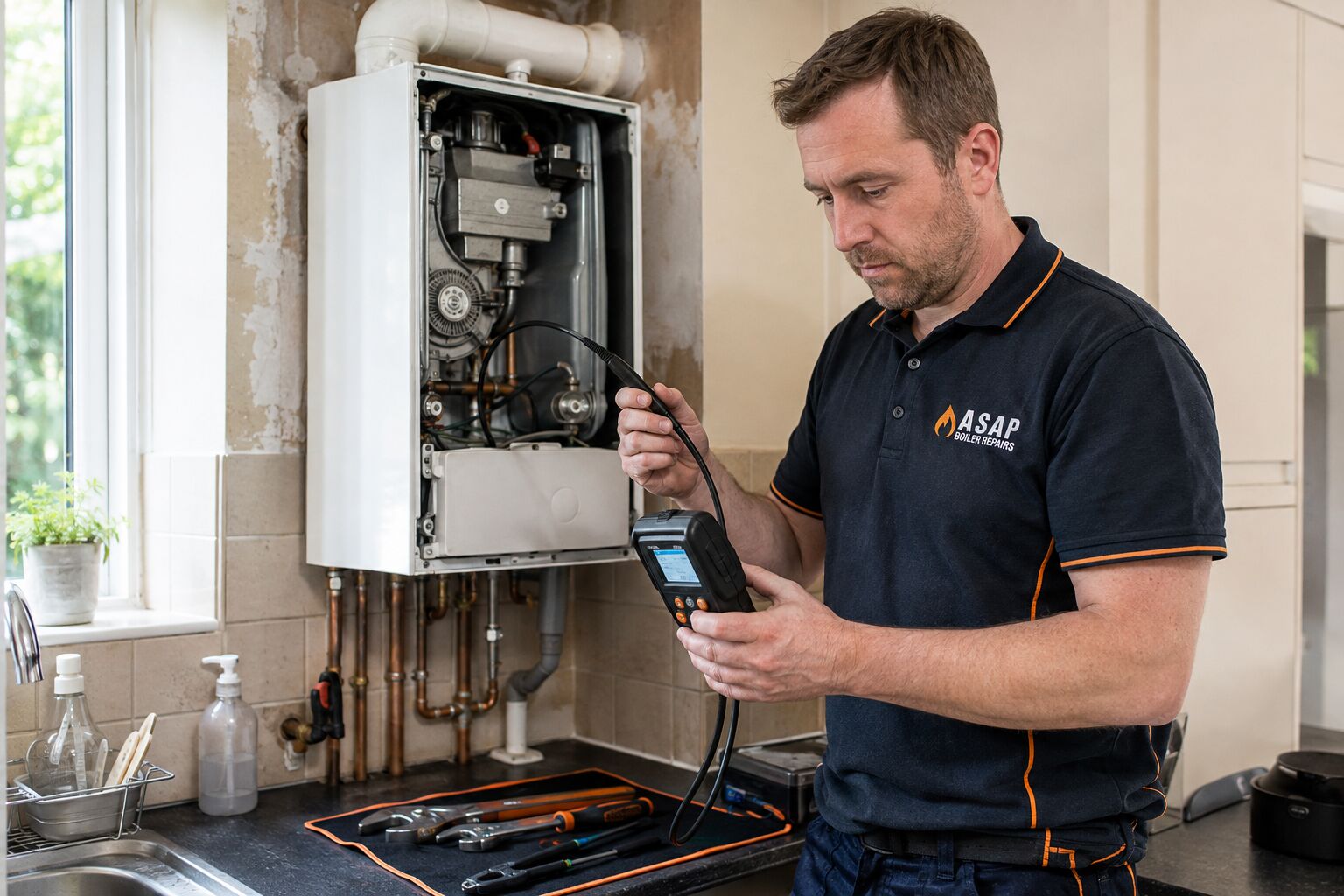
Two very different jobs are sold under this name. Here is the one that is worth paying for.
A service is a measurement exercise, not a cleaning one. The engineer runs the boiler, samples what comes out of the flue with a calibrated analyser, and compares it against the figures the manufacturer publishes for that model. Everything else follows from what those numbers say. On a domestic combi the whole visit runs to roughly three quarters of an hour to an hour and a quarter.
A probe goes into the flue sampling point once the boiler is stable, and the analyser records carbon monoxide, carbon dioxide, oxygen, flue temperature and the ratio between CO and CO2. On most modern boilers it is done at both high and low rate.
Since April 2014 this has been the standard commissioning and servicing method under the industry's Technical Bulletin 143. Modern pre-mix boilers, which is most Worcester Greenstar, Vaillant ecoTEC, Viessmann Vitodens and Ideal Logic, have no manual adjustment screw at all. They can only be set by analyser, so a visit without one cannot have set anything.
The analyser itself has to be calibrated, at least annually against certified reference gas. An out of calibration analyser produces confident numbers that mean nothing.
It is not a repair. If the service finds a failed part, fitting it is separate work with its own agreed rate, and we tell you before touching it rather than adding it to the bill.
It is not a visual check. A look at the flame, a wipe of the casing and a signature is not a service, however it is invoiced. It is also what a good proportion of the market sells.
It is not a system clean. If the readings show the primary side is fouled, that is a power flush conversation and a separate job.
It is not a safety certificate. Those are two different documents produced for two different reasons, which the FAQs below set out properly.
This is the part no other page will tell you. Ask for these four numbers. A real service produces them and a fake one cannot.
| Reading | What good looks like | What it tells you |
|---|---|---|
| CO to CO2 ratio | Below 0.004 | The headline safety number. Combustion is complete |
| Ratio between 0.004 and 0.008 | Not acceptable | Needs investigating before the boiler is left in service |
| Ratio above 0.008 | Stop | The appliance is examined, cleaned and retested, not left running |
| Carbon monoxide in the flue | Under 350 parts per million, and the maker's own figure if lower | Anything over 50 is worth a closer look even when it passes |
| Carbon dioxide at high rate | The figure in that model's instructions | Typically in the 8.5 to 10 per cent band, but only the manual is right |
| Net flue temperature | Low, on a condensing boiler with a cool return | Creeping upward year on year means scale or sludge on the primary side |
The last row is the one worth keeping records for. A single flue temperature tells you very little. The same reading taken three years running, drifting upward, tells you the heat exchanger is fouling long before anything breaks, and that is the difference between a planned flush and a January breakdown.
There is one question that separates a real service from a visual check, and it costs nothing to ask: what was the CO to CO2 ratio? An engineer who did the work will read it off the analyser without pausing. An engineer who did not cannot invent it, because the number has to be recorded and the manufacturer will ask for it if you ever make a warranty claim.
Not sure when yours was last done properly?
Tell us the make and roughly how long it has been. We will say what the service will involve on that model and what it is likely to turn up, before anything is booked.
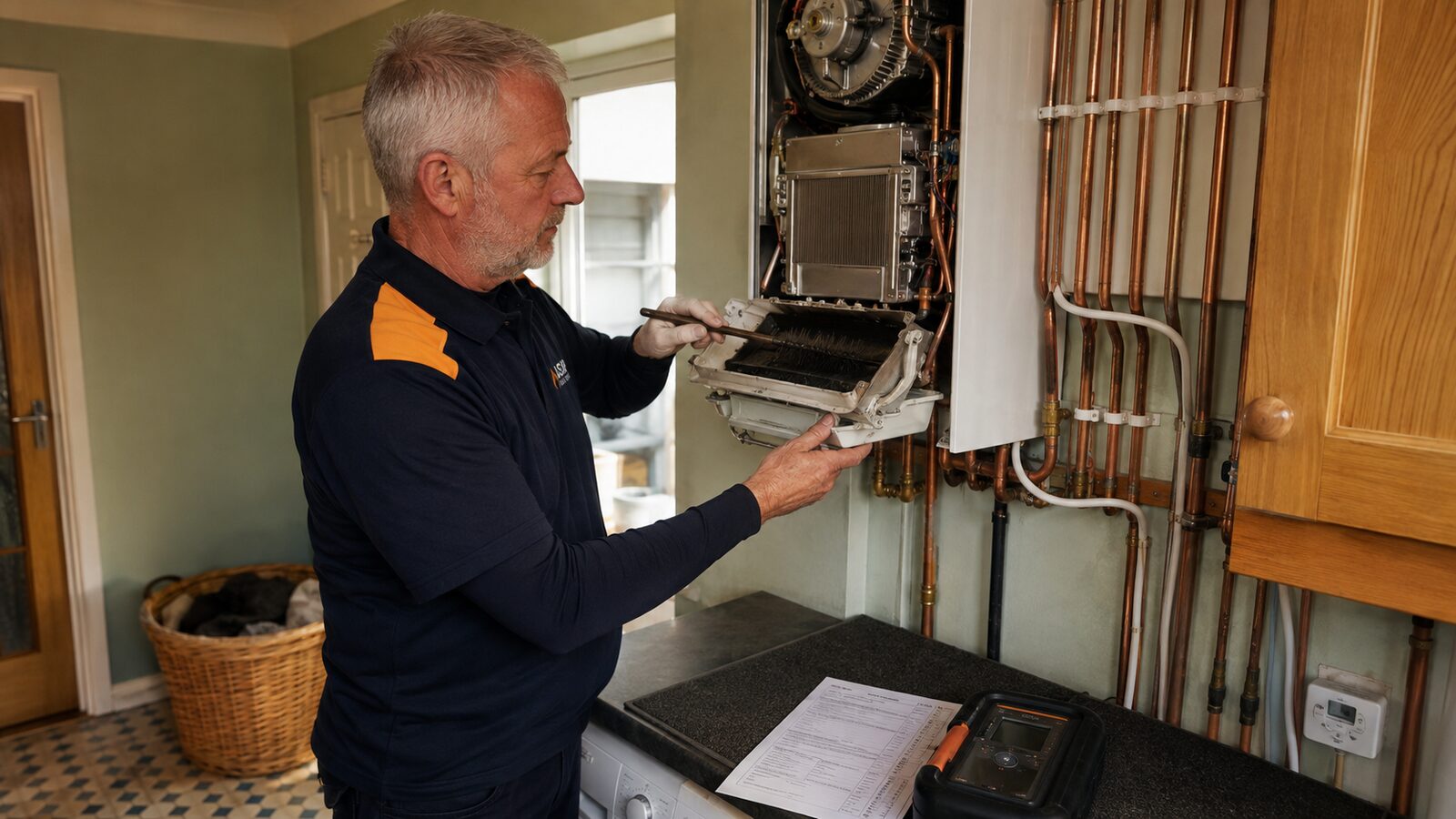
Not a scare story. Three specific consequences, each of which we see every winter.
You are probably wondering whether an annual service is a genuine necessity or a subscription somebody invented. It is a fair question, and the honest answer is that the safety case is real but rare, while the money case is boring and almost universal.
Manufacturer guarantees on modern boilers run five, seven, ten and occasionally twelve years, and nearly all of them are conditional on an annual service being carried out and recorded. Miss one and the cover can lapse, which turns a heat exchanger claim from free into the most expensive repair on the appliance.
Separately, water treatment is a condition too. BS 7593 sets out cleaning, inhibitor and filtration, and failure to comply with it is one of the standard triggers manufacturers reach for when a warranty claim arrives. They do check.
Nearly every emergency we attend in the middle of winter was already showing itself months earlier. A condensate trap silting up. An expansion vessel that has lost its charge, so the pressure drops every few weeks. A condensate pipe run that will freeze the first cold night. A pump getting noisy.
All four are cheap in October and all four are an out of hours emergency boiler repair in January. That is the whole argument for booking in autumn rather than waiting.
Carbon monoxide from a badly burning appliance is rare and it is serious, and the combustion test is what finds it. A ratio drifting above 0.004 is the early signal, well before anybody feels unwell and well before an alarm sounds.
What we will not do is oversell this. Most boilers we test are burning correctly. The point of measuring is that you cannot tell which yours is by looking at the flame, and neither can we.
Fit an audible carbon monoxide alarm regardless, to BS EN 50291, and put it in the room with the appliance. It is not a substitute for a service and a service is not a substitute for it.
The half of the service that has nothing to do with the boiler and decides how long it lasts.
BS 7593 is the standard covering the water in your heating system. It asks for the system to be clean, for a corrosion inhibitor to be present at strength, and for filtration to be fitted. The inhibitor figure worth knowing is a minimum of 300 parts per million. That is a test, not an estimate, and it takes a minute.
London water runs at roughly 277 milligrams of calcium carbonate per litre, and across the city's postcode districts the figure runs from about 250 to over 350. Above 200 the standard asks for scale protection on top of the inhibitor, which puts effectively every London property in scope. It is the same in Highgate, Muswell Hill and Crouch End as it is in Purley and Kenley. Hardness is not uniform and does not follow borough boundaries, so your supplier publishes a figure for your own postcode and it is worth reading before anybody guesses.
The Benchmark checklist came in the box with the boiler. Most people have never opened it.
It is the booklet the installer should have completed on the day of commissioning, and there is a page in it for every annual service afterwards. When a warranty claim goes in, it is the first thing the manufacturer asks to see, and it is what decides whether they treat the boiler as correctly installed and maintained or not.
What should be written in it after a service: the date, the engineer, the Gas Safe registration, and the readings. Not a tick and a signature. If yours has been filled in with a tick for three years running, you have a record of somebody attending rather than a record of anything being tested.
If the book has been lost, that is recoverable, and it is worth sorting before you need it rather than during a claim. We can start a fresh record and note what we found on the first visit, which is better than nothing and considerably better than a shoebox of receipts. For what a repair looks like when a claim fails, our guide to repair costs sets out which parts are the expensive ones.

Timing changes what the visit is worth, and being late is not the problem people think it is.
The month to book is September or October. Not because anything expires then, but because a fault found in autumn is a booked appointment and the same fault found in January is an emergency. Merchants are open, parts are available, and you are not choosing between a cold house and whoever can come tonight.
If you are a year or two overdue, book it anyway and say so on the phone. It changes what we expect to find rather than what we charge for looking. An overdue boiler is more likely to need the condensate trap cleaned properly and the inhibitor restored, and knowing that in advance means the right kit is on the van.
If the boiler is already faulty, a service is the wrong booking. Have it repaired first, or booked as a repair with the service attached, because servicing a boiler that is not working just adds a charge to a visit that was going to happen anyway. That is gas boiler repair rather than servicing.

Local boiler repair specialists
Clear advice. Careful repairs. Family-friendly service.
Call 0203 868 6134London, north and south of the river. These are the districts we work in most.
These are where we work most, not a boundary. An engineer attends anywhere in north London and south London. Tell us where you are and we will say plainly when we can get to you.
If you smell gas: do not touch any switches. Open the windows, leave the property, then call the National Gas Emergency Service on 0800 111 999. That line is free and open 24 hours. Call them before you call us.
If a carbon monoxide alarm is sounding: get everyone out immediately, then call 999 if anyone feels unwell. Do not go back in until the property has been ventilated and checked.
If the boiler locks out repeatedly: try one reset. If it locks out again straight away, stop. Repeated resets hide a fault that is still there, and on a gas appliance that is not a risk worth taking.
Under the Gas Safety (Installation and Use) Regulations 1998, only a Gas Safe registered engineer may work on gas appliances. Never open the boiler casing yourself.
A combustion test with a calibrated analyser is the core of it, recording carbon monoxide, carbon dioxide, the ratio between them and flue temperature, at both high and low rate on most boilers. Around that sits gas pressure measured under load, the condensate trap pulled and flushed, the heat exchanger and burner inspected, seals and flue checked, expansion vessel charge tested, the magnetic filter emptied and the inhibitor strength tested. On a domestic combi it runs to roughly three quarters of an hour to an hour and a quarter.
Ask what the CO to CO2 ratio was. Somebody who did the work reads it off the analyser without hesitating, and it should be below 0.004. Somebody who did not cannot invent a plausible one, because the figure gets recorded and the manufacturer will ask for it on a warranty claim. It is the single most useful question a householder can ask, it takes five seconds, and almost nobody asks it.
No, and they are commonly confused because they are often booked together. A service is maintenance: the appliance is tested, cleaned and adjusted so it keeps working and the guarantee stays valid. A safety check is a legal inspection of the appliances and flues in a rented property, producing a certificate for the landlord. A certificate does not clean or adjust anything, and a service is not a legal document. If you need the certificate, that sits on our landlord gas safety certificate page.
Nothing immediate, which is why people do it. The cost lands in two places. Manufacturer guarantees running five to twelve years are nearly all conditional on an annual service being carried out and recorded, so a gap can lapse the cover on the most expensive part of the boiler. And the faults a service catches cheaply in autumn are the same ones that become out of hours call outs in January. Book it anyway if you are overdue, and say so on the phone so the right parts are on the van.
It is the checklist booklet that came in the box with the boiler, completed by the installer at commissioning, with a page for each annual service afterwards. It matters because it is the first document a manufacturer asks for when a warranty claim arrives. What should be written in it is the date, the engineer, the Gas Safe registration and the actual readings. A tick and a signature is a record that somebody attended, not that anything was tested.
It needs inhibitor at strength and it needs filtering, and both are conditions of most guarantees. BS 7593 asks for a minimum of 300 parts per million of corrosion inhibitor, tested rather than assumed, plus a filter on the return and scale protection where water hardness is above 200 parts per million, which covers effectively all of London. If the readings suggest the system is already fouled, that is a power flush rather than something a service fixes.
Yes, and arguably more than a new one, because the combustion test is doing real safety work on an older heat exchanger rather than confirming a guarantee. What changes is what we do with the result. On an older boiler a creeping flue temperature or a ratio drifting toward 0.004 is worth planning around rather than ignoring, and we will tell you honestly if the sensible move is to start thinking about a boiler installation rather than another service.
London, north and south of the river, across twenty six districts. Highgate, Muswell Hill and Crouch End, Kingston, Coombe and Surbiton, and Purley and Kenley are three of them. We do not qualify coverage by distance or add conditions to particular postcodes. The full list, with the postcodes each one covers, is on our areas we cover page.
Service intervals and the readings each manufacturer publishes differ by make. These pages set out the fault codes and the parts that fail on each.
Every make is listed on the boiler makes we repair. If you would rather write than ring, contact a boiler engineer in London.
Have the model number and the fault code ready if you can. With those two pieces of information we can usually tell you what has failed and what it will take to put right before anybody is booked in.
Gas Safe registered. Unvented cylinder qualified. Parts guaranteed for a year. Covering London, north and south of the river, 24 hours a day.